
Down to the Countryside
notes from the middle of nowhere

Between 1968 and 1978, some 16 to 18 million zhiqing [知青—“educated youth”] in the People’s Republic of China were sent from cities to rural villages in the highlands and outer regions. The reason was not to promote economic stimulus or achieve population redistribution. In the shadow of the Cultural Revolution, it had to be ideological. Bourgeois thought, the Chairman asserted, had infiltrated the minds of the privileged urban youth. As remediation, they were to learn the Maoist ethos firsthand from farmers and laborers. The gaokao, the nationwide university entrance exam, was cancelled. Cadres of Red Guards were splintered and scattered, though their already-wrought havoc could not be easily undone. The movement, incomplete without a political catchphrase, was named [上山下乡]—up the mountains, down to the countryside.
After Mao’s death and the end of the Revolution, the zhiqing could at last return from their rustic exile. The return of the gaokao in 1977 provided a particularly compelling motive to do so, for most had only received an elementary or high school education. Many, who had already married and started families, did not. The loss of a decade, more or less, of schooling nationwide produced a new lost generation. Many scar literature authors in the following years were themselves zhiqing, writing stories based on their lived experiences.
My father was fortunately young enough to have been spared from this movement. But even if he had been born ten years earlier, in the generation of those banished youth, the movement would not have affected him at all, for he would have needed no relocation. As the Revolution raged on, he was already in the deep country. He was born of it. He was made from it.
The Shen family once lived in the Middle of Nowhere, Yuanling County, Huaihua Prefecture, Hunan Province, PRC. My father was raised there, among the violently verdant forests, chattering creeks, and humbling heat of the hills which precurse the Guizhou plateau in the western part of the province.
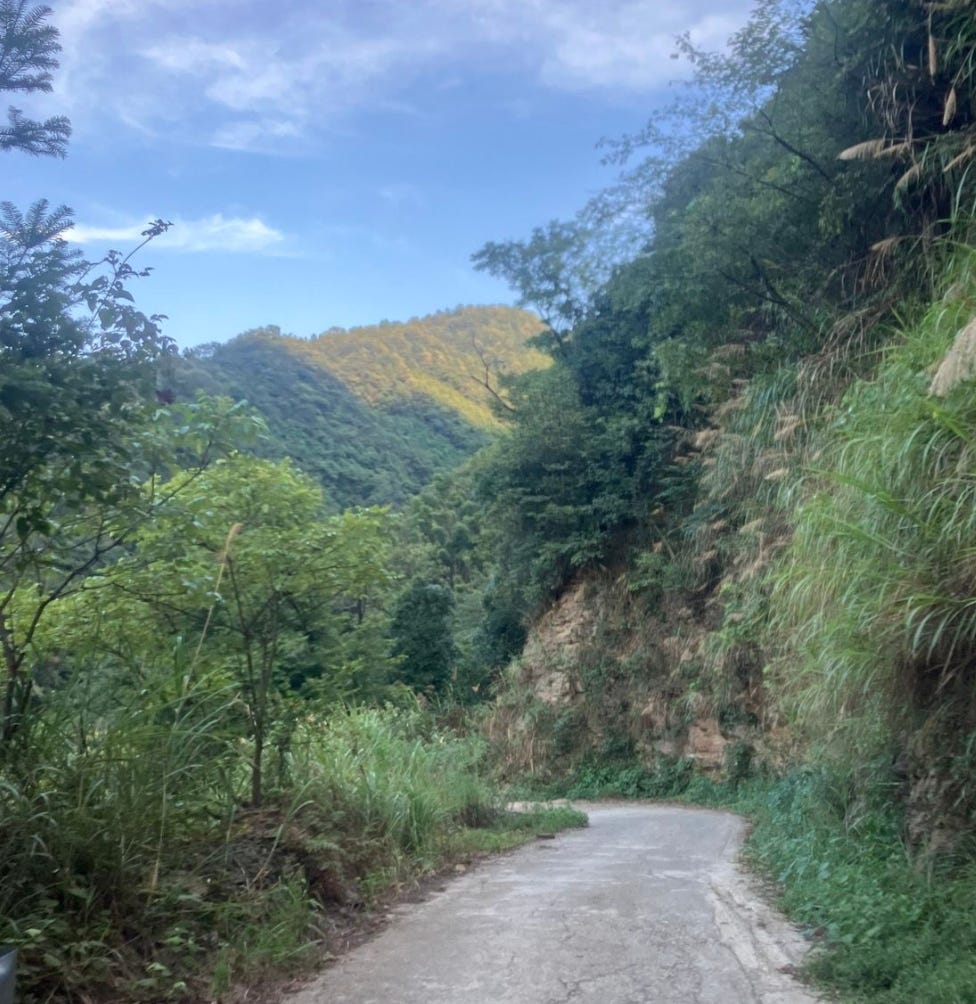
The mountains there are small and dense, hundreds upon thousands of ridges clumping together. They are well-weathered, no more than a couple hundred meters in height and covered in thick vegetation that resembles moss from afar. There are scattered fields of crops, but farming beyond subsistence is impractical given the absence of flat land. So for the most part it is sparsely inhabited, though less so than you think. Unlike most chains or even foothills, there are no scenic points, no sense of grand composition. The creeks wind too much, the peaks pack too close together, the trees are too tall. Instead, you get a monotony of unnamed crests and troughs for leagues in every direction, wrinkles of Earth, unappealing and then beautiful in the way that wrinkles are.
Breaking this monotony is the Yuan River [沅江], one of the Yangtze’s four primary tributaries that flows through the province before merging with it in Dongting Lake (from which the province hu-nan [湖南—“south of the lake”] gets its name). At its closest point, the Yuan passes about five miles north of the Middle of Nowhere. Several ridges straddle that distance, though, so it’s impossible to know of the water’s presence until a turn around the corner puts you right beside it. Upstream is Yuanling town [沅陵—“hill on Yuan”] proper, the closest municipality. Nearby is the Wuqiangxi Dam, used for flood control and power generation. When it was constructed in the late 1980s, the reservoir it formed submerged much of Yuanling. New bridges were planned, necessary structures were rebuilt, and the past was efficiently discarded.
Northeast of Yuanling, near the border with Hubei, is a town formerly named Dayong [大庸]. Four hundred million years ago, when the region was a shallow sea, a period of tectonic activity gradually blanketed layers of sandstone and quartz on the ground. Over the vast eras since, the infinitesimal force of water eroded deep chasms across this bedrock, carving an intricate patchwork of curiously thin pillars hundreds of meters tall. Aided by the humid climate, the forest came to settle upon this impossible landscape, creating a lush and discontinuous jungle spread across three dimensions, a unique environmental marvel.
Due to its isolated location, this area, Wulingyuan [武陵源] and its beauty were not widely known until the late 1980s. But once word got out, Wulingyuan would know peace no longer. In 1992 it was declared a UNESCO World Heritage Site. In 1994 the government, realizing the potential of this region, christened Dayong with a catchier name: Zhangjiajie [张家界]. Today it is one of the largest travel destinations in China. With its hotels and cultural shows and tourist traps, it resembles Vegas more than a mountain town. The gaotie [高铁—high-speed rail] network has extended its tendrils there, cutting through fields and blasting through stone on tunnels and viaducts of concrete. A scrambled network of roads connect its greatest hits, governed by an infantry of shuttle bus drivers who seem to know the exact physical dimensions of their vehicles by the way they careen around the switchbacks. Several trams and gondolas have been built, the world’s tallest outdoor elevator too, parasitically clinging onto the cliffs. Yet these engineering feats are no match for the hordes of sightseers. One impressive cablecar ascends from the town to the peak of Tianmen Mountain, five miles and four thousand vertical feet away, renowned for its breathtaking natural arch. More impressive and breathtaking is the queue for the ride, which snakes up three floors of a specially-built terminal and takes three hours to get through on a good day. At the top you are welcomed by a network of trails packed so densely they are effectively an extension of the line you thought you escaped. Better grab some milk tea from the food court and take a breather.
You experience this highly-catered destination in a process as streamlined as a factory line. You arrive at the sprawling gaotie station, located a quick convenient drive from downtown. You take buses everywhere you want to go and buy tickets for everything. After three or four nights with your group, and with your camera roll filled, you leave as swiftly as you came. Amid this meticulous logistical operation that is modern-day tourism, there is little actual understanding for the people who call this place home. Wulingyuan, in its aggressive optimization, has become a bubble, giving the traveler the carefully-crafted story they want without exposing the staid reality that lies past the city limits. As the bird flies, in fact, the Middle of Nowhere is within fifty miles of Zhangjiajie, but you would never have known. Cross the mountain pass and the boulevard vanishes; only an arduous commute lies ahead.
Today the fastest way to the Middle of Nowhere from Yuanling is via a 90-minute speedboat ride down the Yuan followed by a meandering drive up a mountain road. There are no other remotely direct routes. Maps assign this road a varying state of existence; on OpenStreetMap, it appears, it does not exist at all. Google and Apple mark an unnamed road that disappears a couple miles in. Only Baidu reveals a thin line upon which is strung an assortment of pinyin district names scraped from government databases. The most information can be gleaned from satellite imagery and topographic maps, captured from above and aggregated by code written by engineers who could not know less about this land.
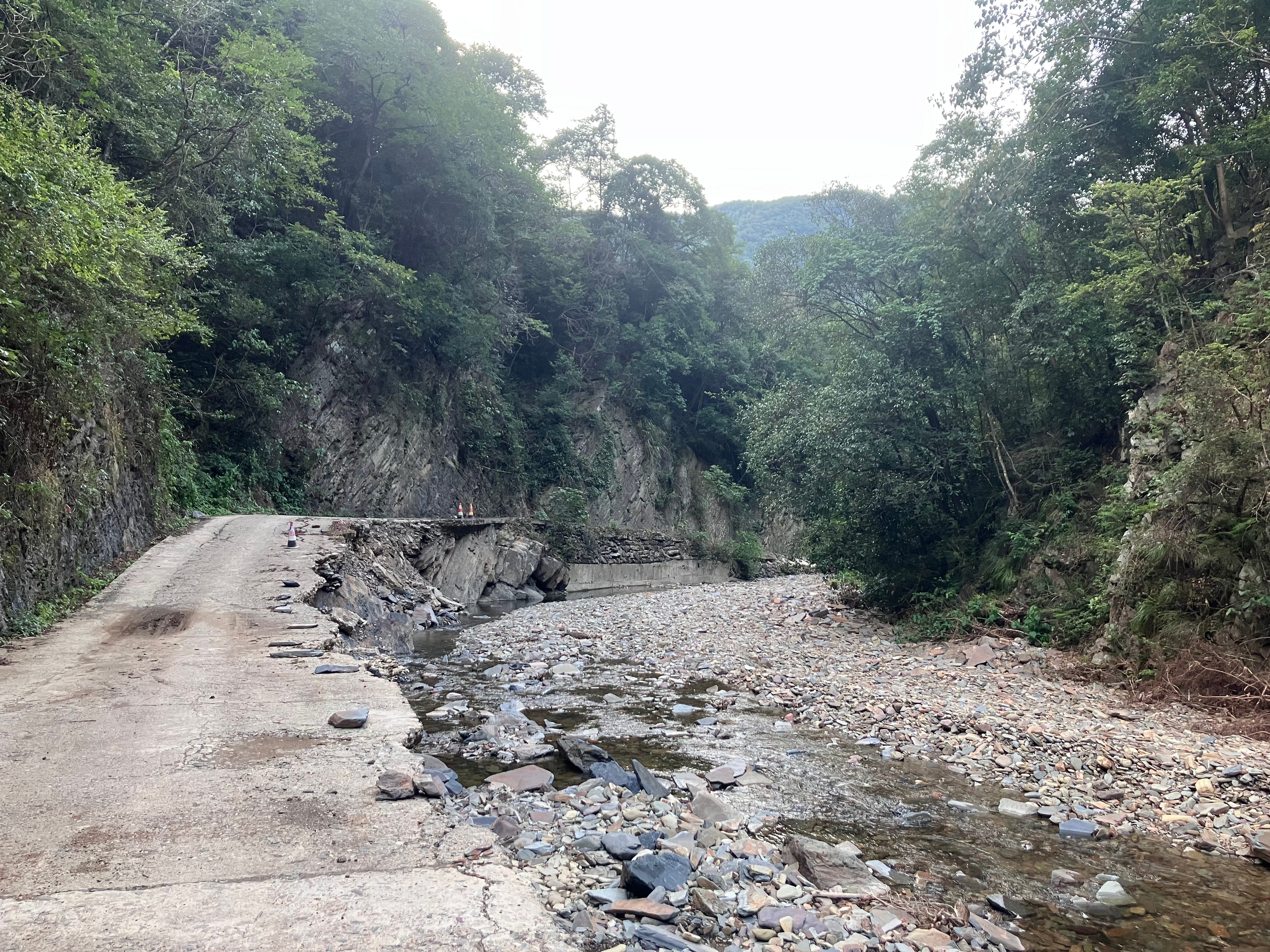
The road is indeed nothing more than a grey thread that follows a creek through a valley. It starts at the Yuan—more precisely, it starts from the Yuan, as the pavement, emerging from the perpetually-swollen reservoir, doubles as a makeshift pier. The road possesses of course the usual characteristics of mountain routes: upsetting grades, infuriating switchbacks, low visibility. There are also places, however, where it may well be better described as gravel or singletrack. Where it dips and runs next to the creek, the stronger and more frequent flooding as of late has caused some sections to partially collapse, leaving room for one car if you squint and cross your fingers. Maintaining infrastructure like this is not high on the government’s list of concerns.
Somewhere on one of these mountaintops a thousand feet above, there is a decaying complex of wood, the remnants of the village my father once called home. Sixty years ago it was home to eleven families, all distant relatives somehow, for they all shared the name Shen [沈]. In total there were some sixty inhabitants. Grandpa was one. An acquaintance thought he was smart, quite liao bu qi [了不起—“fantastic stuff”] really, and introduced him to their niece. One thing led to another and then there was Dad.
My father was the eldest of four siblings, followed by a sister and two brothers. As was tradition, each boy was given a jian ming [贱名—“junk name”], a foul-sounding nickname so to deter the spirits from adopting such a terribly-named boy themselves, serving as a verbal talisman of protection in a time of high infant mortality. Thus Dad became known as ma-gou [麻狗—“leper dog”] and his brothers wu-ter [武头—“weapon head”] and hao-mei [好妹—“nice little sister”].
Grandpa and Grandma ruled strictly in a truly local world. The road had not yet been paved, so communication with civilization at large was conducted either by landline or by foot. Access to running water came from, well, just that: A stream cascaded down the side of the mountain, an all-in-one tap, bath, and cooling station. Living off the land was tractable enough, but making money was a different matter. “Automation” and “scale” were concepts that did not exist. Small clearings could be used for limited agricultural activities, but the most profitable labor was found in the forest. One would clear narrow channels up a hill, first cutting down trees, and then, with a push, send the logs rolling. Amassed by the creek, the next step was to wait for the next flood to sweep the wood out to the Yuan, where merchant vehicles would hopefully await. With Grandpa’s bartering acumen, the household made enough to get by. Everyone was poor; in the country, you were at least shrouded from it by the wealth of nature. The moisture kept your skin glowing. The food was reliable: it was not wet enough for rice, but corn and yams did the job. And the work made you tough.
In the village there was a teacher who offered elementary education to the six or seven kids present, but the closest schoolhouse proper was by the Yuan. Starting around Grade 5, Dad would stay there on weekdays, trekking to and from the village on Sundays and Fridays before leaving for high school in Yuanling. Coming home once, he passed by a wild cherry tree bearing fruit. Naturally, he climbed up and began feasting. Unfortunately the cherries must have been too ripe and too many, for my father, overwhelmed by the fermentation, became tipsy and fell out.
The paving of the road in the 1990s brought about a leap in mobility. Many residents, their world suddenly much bigger, moved out. The aging found their bodies increasingly unwilling to cooperate with the climbs up to the village. The Shens diffused. Dad went to university and soon became the financial anchor of the family, forgoing grad school to help pay for his brothers’ tuitions.
In 2022, our family hired contractors to build a new house by the road, giving my grandparents a way to stay with the mountains. After Grandpa passed, Grandma became its sole denizen. With a driveway and four bedrooms it is, at last, a structure capable of handling the whole family. Keenly aware of the torrential rain here that can liquefy the mountainsides into currents of sludge, the contractors strategically dug drainage ditches around the perimeter of the lot. With the creature comforts of wi-fi, AC units, and a HD TV, this house is a luxury upgrade from its predecessor, bearing the common decorative elements—a shiny gate, beige brick and maroon tiles, golden embellishments above the windows and bright red vertical banners bearing good tidings on the doors. Still there are pithy reminders of a pre-abundance world. By the entrance there is a small garden with gourds and cucumbers. Behind the house is a corrugated metal shack piled up with chopped logs and dried bamboo—firewood, gathered for winters, no longer needed. Adjoining the kitchen is a side room where chunks of carcass hang on strings tied onto suspended metal hooks: a homegrown meat curing operation. Across the street is a concrete hut whose roof has partially caved, abandoned by its owners.
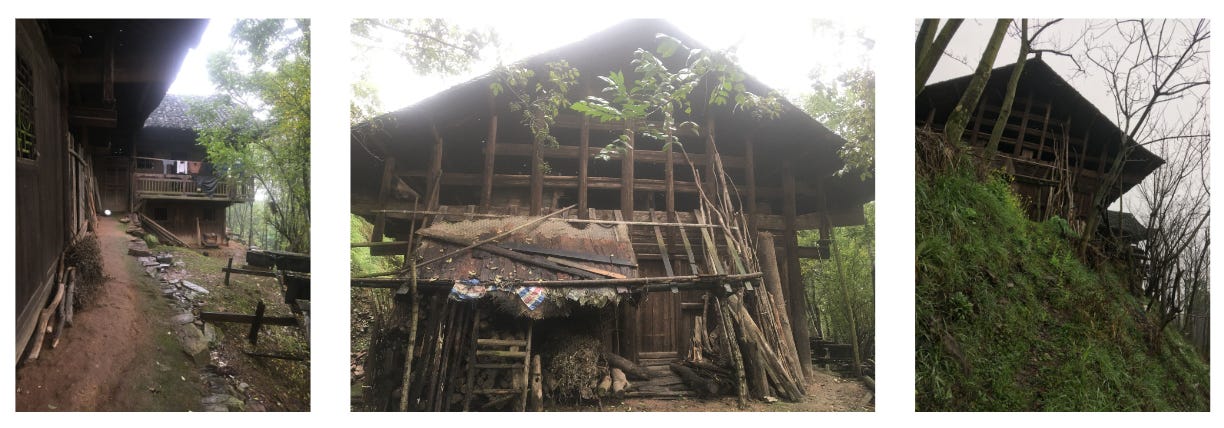
One of the last times that the village saw people other than my grandparents was in 2014, when my extended family visited. Grandpa killed a chicken on a tree stump with a hatchet and cooked it for lunch, and I realized that I was the first in my family line to have never slaughtered livestock. Alcohol was drank and poker hands were dealt, but I, unqualified for either, instead played through Plants vs. Zombies on an iPad. Despite applying profuse volumes of repellent, I received no less than thirty mosquito bites. It was as if the bugs there never learned to hate DEET. We slept on mats on the floor, and one night a chunk of wasp nest up in the rafters fell onto the ground two inches from my left ear.
Memories fade but digital photos don’t, so although my personal recollections are weak, pictures captured on iPhone 4Ss and Fujifilm point-and-shoots serve as backup, a form of external storage. I must have been impressed by the house’s size. With two stories, balconies, and even electricity, it looks like a kid’s dream treehouse, or something you’d see on a YouTube wilderness survival channel. But whereas the treehouse remains a dream, and the YouTuber has recording equipment and a subscriber base for which to produce content, this house just is. It is as it has been and will be until it is not, assimilating back into the forest until its ruins can no longer be distinguished from the flora that grow upon it.
In August 2024 I find myself on the speedboat from Yuanling with family and a flock of locals. The cabin is cramped, but we lose in comfort we gain in speed. Ripping down the channel, we zip by dark and dilapidated freight barges as if they were standing still. Hilltops bound the sides of the river, some with dwellings atop. As we pass one I suddenly hear a loud banging. I turn and see wisps of grey smoke, punctuated by flashes of white—firecrackers—that strike me with a tinge of mystery and solemnity. What ritual, celebration, or mourning might the residents of that household be undertaking? What part of the story of their lives was being written? How strangely poetic that we were the ones to coincidentally witness it, and how momentarily tragic that we would never know anything more.
It is so humid that the air feels thick, saturated with moisture to the point of viscosity. I try to sit still, afraid that any movement might exacerbate my perspiration. The captain, of course, must stay hydrated too, and he swigs from a plastic water bottle. When he is empty, he chucks it out the window. It lands quietly on the surface of the river and vanishes from sight. I am taken aback first by the captain’s indifference to his blatant act of littering, and then, after a moment of thought, by the fact that despite his habits, he will likely never pollute or damage the environment nearly as much as I, with my Western lifestyle, already have.
Every ten minutes the boat stops sputtering and glides to the water’s edge, pausing next to sometimes a dock but more often a bank of pebbles, and a passenger with bags of groceries or a small child in hand climbs out, walks along the gunwale to the bow, and jumps onto the land. This method of departure is an order of magnitude faster than docking and properly disembarking. When it is time for me to leave, I look extremely out of place with my suitcase, and the captain has to assist me out.
At the riverbank haomei is waiting, having driven over to pick us up. The vehicle he’s in hints at how far he’s come: a white Mercedes SUV, navigated from Changsha the day before and suffering only one flat tire in the process. We make full use of the car’s 4MATIC going up the road, which is so bumpy that my phone starts counting steps. At especially gnarly points we stop to move aside chunks of concrete scattered on the pavement. As my uncle knows, an experienced driver must put aside their concerns about fuel economy and furiously accelerate and brake as needed, beeping fervently before every turn to warn others of their approach. In this way we blaze through fifteen kilometers in just over half an hour.
Occasionally a few houses of varying decrepitude arise from the undergrowth, where there can be found wandering chickens, pigs, dogs, and sometimes humans. A farmer dips into the bush to allow us to pass, and a crowd of two dozen ducks follows him. The auditory landscape is most intriguing: the rustling of leaves in the sticky breeze and the white noise of cicadas, interrupted every so often by the bark of a stray dog, the objections of a rooster, or the rattling of a bengbengche [蹦蹦车—lit. “bounce car”, a compact motor tricycle]. This is the sound of home.
It is probably unsurprising that the Middle of Nowhere does not feature that much to do. This is particularly the case during the summer, when the direct sun and brutal heat preclude any prospect of outdoor adventuring. Time, fortunately, moves faster during these languid days. After a meal has been eaten and the beer drank and watermelon slurped and sunflower seeds cracked and dishes scrubbed, it’s already time to prepare for the next one. The conversations linger for hours. Something about the environment propels my father to start chattering about his childhood, a topic for which he, loath to tell stories, would typically only reference in passing. There’s much entertainment on TV since the Olympics are occurring, so in the evenings we watch the day’s highlights in badminton, table tennis, swimming, diving, and shooting. It seems like China is easily crushing the competition!
I am teased a lot in that familial way. I am foremost teased for my pathetic heat sensitivity, how my forehead glistens when everyone else is cool, my damp discomfort sitting in the shade with a paper fan and the way I begin dripping the moment I step into the sun. I end up spending most afternoons holed up in the air-conditioned bedroom, curtains drawn and door closed shut to preserve the coolness. Without cell service, behind the Great Firewall, and too lazy to have set up a VPN, I read books I’ve downloaded as PDFs on my laptop, passing the time in my little alcove.
I am bullied for my devastatingly low spice tolerance and unadapted palette. To their merit, I quickly discover that much of the Hunanese cuisine we cook is entirely unlike what I am used to. The cured meat is strong and pungent and necessitates dilution with spoonfuls of white rice, to enjoy the pan-fried crayfish and small fishes requires a certain skill and comfort with handing viscera that I lack, and the sea cucumbers, a hard-to-get delicacy viewed as a miracle food in the region, are like blackened gamey alien eggs when steamed. I stick to the smashed cucumber, caramelized pork belly, cold lotus root, cumin-spiced spare ribs, and stir-fried green beans, the closest approximations to the American-Chinese food I know. We devour meals in a way that makes me wonder if having table manners (or a lack thereof) is an inherited trait, and anyhow if dining etiquette is just a distraction from the true point of eating, which is to drop the pretense and enjoy the food any way you please.
My relatives, some of whom I didn’t even know I had, poke fun at my broken Chinese, which sounds more anglicized year over year. While I’d consider myself still passably conversational, my vocabulary has atrophied to the point where I can’t recall many of the household phrases and four-character idioms in the vernacular. Perhaps as a consequence of how learned languages are lost, my listening comprehension remains relatively strong, so I eavesdrop on conversations with no meaningful way to contribute in return. Even this is difficult, for everyone regresses to the regional accent they were raised speaking, and as an additional layer of complexity, Grandma is hard of hearing. Most times my father sits between us and acts as a translator between dialects. We end up exchanging few words. She seems contented enough just seeing me again, and I realize that the stories she has to tell have already been passed on to her own children. It is now their duty to someday pass them on in turn.
One evening, as the sun has began to set, I don a tank top and shorts and decide to set out on a jog on the road. These hills have never before witnessed such a thing. Within ten minutes I have decided to settle for powerwalking, my clothes completely soaked and my quads burning from the steep ups and downs. A dog senses an intruder and leaps out of the brush, lurching forward and growling. I usually think of myself as pretty good with animals but I’m not going to roll the dice on this one. It takes a few minutes for the owner to hear the commotion and straggle over, recalling his companion with a few barks while staring at me in equal bemusement. The patter of my steps draws the attention of a mother skipping stones with her two kids, and they look up as if a UFO were passing by. With no streetlights, the dusk approaches deceivingly fast. My instincts set in and I hightail it back home, lest I face the darkness—or worse, come across some unknown light.
The one thing we can do outside during the day is to wade in the stream. The easiest way there from the house is to cut behind the abandoned hut, walk along a small ditch that has come to serve as the improvised landfill, and cautiously step down a notch in the gravelly riverbank. The whole journey cannot be more than a hundred meters but is fairly technical in flip-flops. In the dry season the water is mostly knee-deep, but there are little nooks and crannies where, after checking for cobwebs and bugs, you can lay down jacuzzi-style in the canopy shade. Though some of the trash has made it to the riverside, the water is as fresh as it gets otherwise, blissfully clear and crisply cool. Actually, the tin cans and plastic cups scattered around prove to be helpful tools for catching the tiny fish which hide under pebbles and leaves. There are small crabs, too, and haomei shows off his talent in collecting them. The skill lies not in hunting them down but catching them without getting pinched. With your thumb and middle finger you must attack from behind, squeezing the sides of the crab so its claws can’t reach you. To lift it out of the water and check it out up close, you should then press your index finger on the shell behind the eyes for stability. Playing around this way, time flows like the water itself—rushing then abating, circling in eddies.
When Grandpa turned 60 he began to prepare for his death. With the space in the country, he had the rare privilege to plan for a burial rather than a cremation. Scouting the parcels of land that he owned, he selected the largest trees and had them cut them down to assemble the finest casket possible.
He left quickly at the end; it seems that the decades of smoking had finally caught up. My father was among the men who hauled the casket up to the clearing Grandpa had marked as his preferred resting place. There they also erected a memorial for the old Shen—more a shrine than a grave, decorated and stately, a marker of the prosperity of the family he’d sired, emblazoned with his full formal name and epithets (which I’d never learned) and a family tree doubling as a chronology of his life, at which sticks of incense, bottles of tea, cups of wine, and bags of fruit would be placed. The spirits here take money, too—jinzhi (金纸—joss paper), sheets of thin and rough paper-mache colored a light yellow-beige to be offered by being folded and burned. Our jinzhi is modest, lacking text or illustration, with only subtle perforations as decoration.
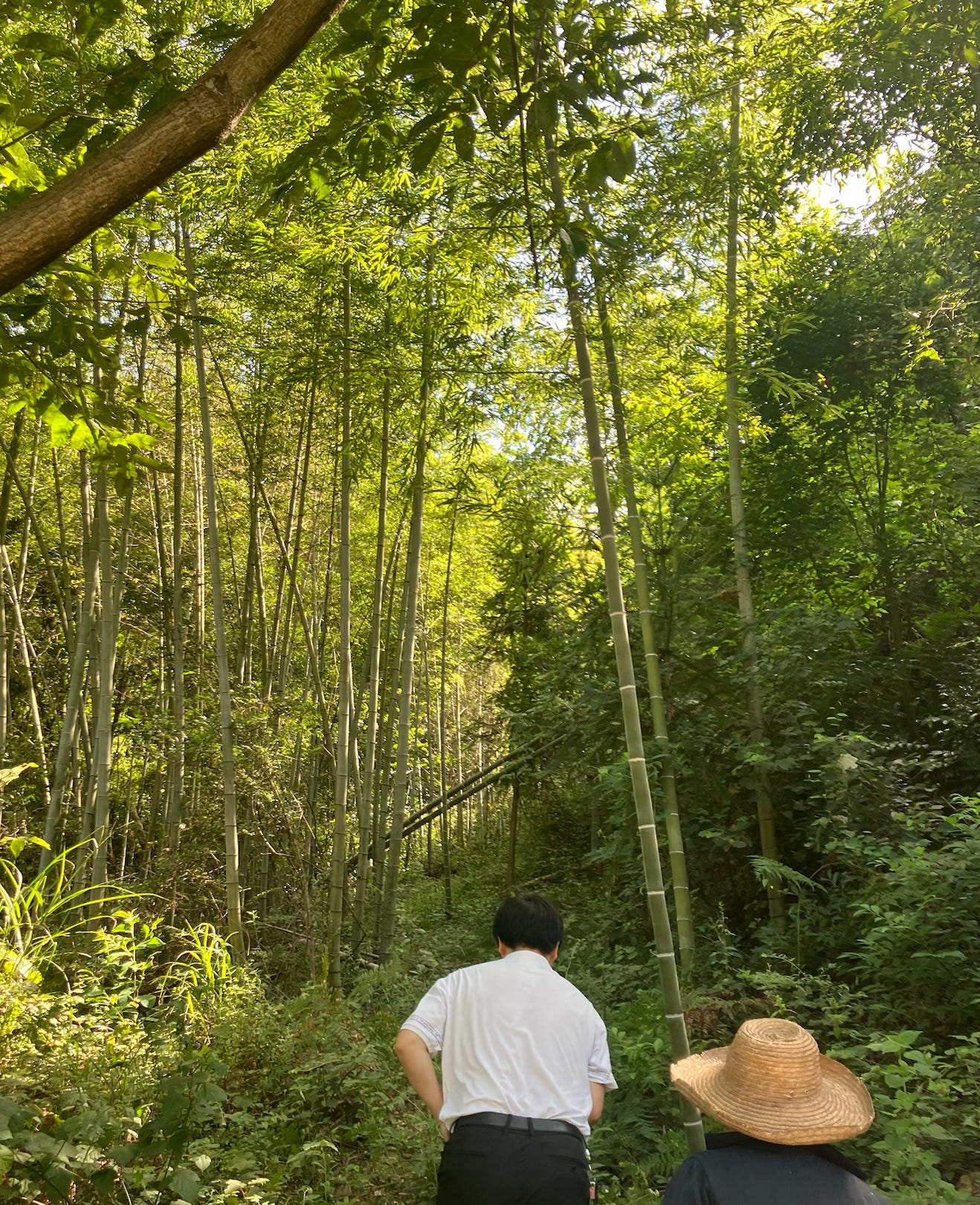
There is no path to the clearing itself. Visits are made with a scythe in hand, bushwacking through bamboo sprouts and keeping wary of loose soil and roots. As it takes but a few weeks for the vegetation to settle in again, the entrance is indistinguishable from the forest, its precise location a secret cautiously kept.
At four in the morning ten days before the anniversary of Grandpa’s death, we open wide the doors of the house and begin to burn jinzhi on a plate in the foyer. Grandma steps out and surveys the darkness. “回来吧”, she calls, and we set off a roll of firecrackers. For two minutes they erupt, sparks of rose lightning that shatter the stillness, signals illuminating the darkness to beckon his spirit back. My father steps out too. I ask him what he is doing and he replies that he’s stepping out for a smoke with Dad.
For the next ten days, the front doors stay open so that Grandpa may enter or leave as he pleases. During the daytime, the shade and coolness attract a convocation of insects who make themselves at home. A large grasshopper enters one morning and rests on the couch armrest through the evening, as if they are watching TV with us. We let them be. They could be Grandpa.
After attending the same schoolhouse as my father, wuter skipped high school, opting to attend a vocational college. It was not until later that he completed a Bachelor’s in Nanjing, a Master’s in Beijing, and a PhD in the US. For a while he lived in Indiana, and our family once took a road trip from Toronto to see him, though any memories I had therein have been reclaimed by time. After he accepted a professorship in Hunan and his family moved back to China, I would call my cousin every few months to help sharpen his English, but somewhere down the line, maybe around when COVID hit, we stopped and never thought about it again. Haomei went into pedagogy instead, and now teaches at one of the most competitive middle schools in Changsha. Propelled by a mushrooming economy and genuine hard work, these children by objective means did incredibly successfully, making it to a point where one can buy white Mercedes SUVs and hire contractors to build houses.
Except for my aunt. As was said back then and even now, zhong nan qing nu [重男轻女]—weight the sons, leave the daughters. My aunt is unemployed, dividing her time between taking care of her grandson (a truly spoiled kid if I ever saw one, an exemplar of the iPad generation) and helping Grandma take care of the country house. She is barely literate, having never received formal education. She has never left the country or even flown for that matter. Her first trip on the gaotie was when our family took her along to visiting Zhangjiajie. The Shens were infected by and spread forth the dry rot of gender bias that was endemic to the culture back then and pervades yet. How do you handle the quiet outrage from living a life strangled? How do you confront the latent resentment for a departed patriarch who raised you and then kept you behind? I have not thought deeply about these questions. Perhaps they fall beyond my jurisdiction: only my aunt can truly ever form an answer.
Yuanling County has strived to build out a tourism platform of its own in the past few years. On the drive from Zhangjiajie, a single-lane side road branches off and leads to a miniature water park neatly nestled in geographical obscurity. There is a ticket stand and an electronic turnstile which have seen scant usage based on the few visitors I see splashing around. Near Yuanling is the “Eryou Education Cave”, a historic building complex sitting on a clifftop overlooking the confluence of two rivers, said to have been a hiding place for monks to store scrolls during the cultural purges in centuries past. It features a museum exhibit which, like many projects in China, gives the feeling of being 85% complete in perpetuity—well-planned and spotless, until it unexpectedly isn’t, and you see the exposed wire and unpainted drywall. Close by is a board on which local high schoolers have written messages of hope ahead of the gaokao. Yet the absence of other visitors and the disquieting silence of the place tell me that, like Yuanling wholly, this is a place worth discovering but nonetheless overlooked, trying its best to break out of anonymity but seeing little success. With the economic impact of the pandemic, they never had a fighting chance. For now the region merely exists, known only really to itself, frozen down while its peers push ahead.
The government is currently completing a section of G59—the new Hubei Expressway—which will dispassionately slice through the hills only a few kilometers away from the Middle of Nowhere. Across the Yuan, two massive concrete towers stand, awaiting a bridge to support and heralding the impending development to come. There are few planned exits in the region, such that accessing our home will still require a long trek off the exit. After all, the main purpose of this section of expressway is to connect some more southern cities, like Shaoyang and Loudi, with Zhangjiajie. Ironically, construction vehicles currently rely on sections of the country road our home lies on to supply materials for the expressway’s construction, further cracking the struggling concrete.
As long as Grandma’s still around we have a good reason to visit, but we know well that these days are numbered. She is a thin strand connecting us with the countryside that, once cut, will likely complete the severance of the Shen family from its modest origins. My upbringing in the West is a continuation of our generational migration, a fact which is not lost on me especially given how I am writing this piece in English and will rely on Google to translate it before sending it to my relatives.
The disconnect I felt in the Middle of Nowhere and feel still is something to recognize and mourn, but also a natural consequence of the way we evolve, adapt and flourish. To do so non-destructively, in a way that keeps us aware of what we might be leaving behind while forging ahead, requires thought and reflection without exaggeration and over-sentimentality. My alienation from home and the steeped tradition of that Asian Appalachia is not unlike our collective alienation from a nature we seem to have nowadays overcome in our cities of steel and glass, and as stereotypical as it sounds, most of us could do well to be reminded of our roots. At the same time, it is too easy to dramatize the past. Our ancestral village, imminently disappearing, fits nicely into the trope of some ancient ruin forever swallowed by the jungle. But there’s no mythos here: what was here was completely human and only so, a simple reality that, like the concept of home itself, is inevitably ephemeral.
How can we try to carry forward the past in stride? Maybe a measured awareness, with a sense of discretion and good faith, is a reasonable starting heuristic. While it’s something our family has largely moved beyond, I don’t think that my pastoral provenance, the spirit of which still lives today, should be condemned to live in liminality, always on the edge of recognition. It seems that, as a child of Chinese immigrants, your parents seldom mention anything pre-you, and anyway don’t have good reason to, given that your existence lies solely within a post-departure life. But storytelling is more powerful than we think, an act of remembrance and celebration, analogous to the way that I write here as a way of committing to memory, a rebellion against forgetting.
It’s said, too, that travel is a way of experiencing living history, and when done well I sincerely believe this, in its power to encourage contemplation and the gathering of insight. Sadly, I think that this meaning is all too easily lost, overshadowed by commercialization, commodification, and sensationalism. Making the effort to consciously go beyond the superfluous is tough, not our default mode of behavior particularly when we’re chiefly trying to have fun and the tourism machine discourages it, but worth it. Certainly, there were more conventional things I did that summer in China. We saw mist float through the cliffs of Wulingyuan, dined on some superb hot pot by Beijing’s Second Ring Road, and climbed the steps up Huangshan. Yet by far and away, the days that most challenged and enlightened me, where I witnessed ignoble ugliness and subtle beauty, felt simple joy and muted sorrow—they were indisputably those days of nothing, among those nameless mountains in the middle of nowhere.
you could submit this as your english 185e final essay and it’d get an A
Incredible story