
PR or ER
the most dubious race recap you'll ever read

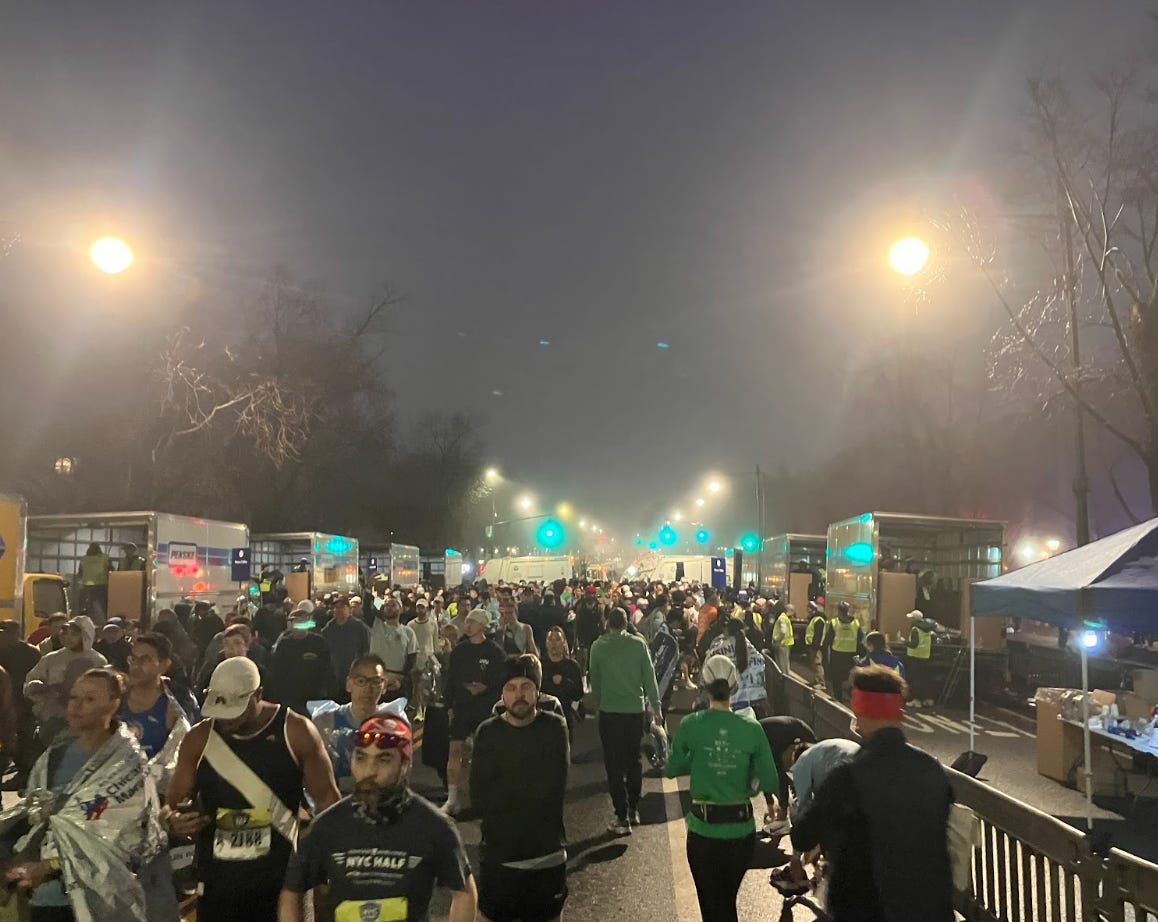
Bib 2741 began the United Airlines NYC Half on 16 March 2025 but did not finish.
Here is what his timing chip reveals. 2741 began at 7:23 AM in Wave 1, near the front of a mass of nearly thirty thousand runners that would toe the line in Crown Heights. After entering Prospect Park and climbing up Battle Pass Hill, he passed the first 5K at 7:44. At 8:05, just after crossing the Brooklyn Bridge, he hit the 10K mark. The next 5K, an onerous stretch of the race that winds up FDR Drive before exiting onto 42nd Street into Times Square, he completed by 8:26. And he crossed 20K, in Central Park right before the turn onto the finish line, at 8:48.
Unknown to the timing chip, 2741 had entered this race ambitiously, with a mission: a sub-90 finish. 2741 was a occupant of that grey area that many find themselves in after a few years of recreational running: too fast to discount themselves as a novice, yet not fast enough to substantiate themselves as serious. Far more committed than the completionist who runs one marathon and calls it quits, but a decent way off from a seasoned athlete contending for a BQ. In other words, 2741 had something to prove. In between ends, he had made the monumental and unusual choice to Really Try, to draw some rather arbitrary threshold of worthiness and dare himself to make meaning out of crossing it, to bring a touch of gravitas to a hobby. Above all, he had faced and accepted the paramount risk of coming across as an obnoxious hardo, and in so doing became ipso facto exactly such a hardo.
2741 was excited, fired up, possibly a bit feverish. The NYC Half was a flagship spring race in the city, so he had to show up and show off. He intended to leave it all on the road that morning. In previous races he’d been too conservative, he’d said at run club—he’d finished with gas still left in the tank, leaving the question yet unanswered what “max effort” felt like. The half marathon distance is a prime candidate for this kind of calibration: long enough such that you must think about your pacing and aren’t truly in agony the whole time, but short enough such that extraneous factors like bathroom breaks, bonks, and injuries are largely out of question, and an ability to maintain a sustained and uncomfortable intensity dominates the calculus.
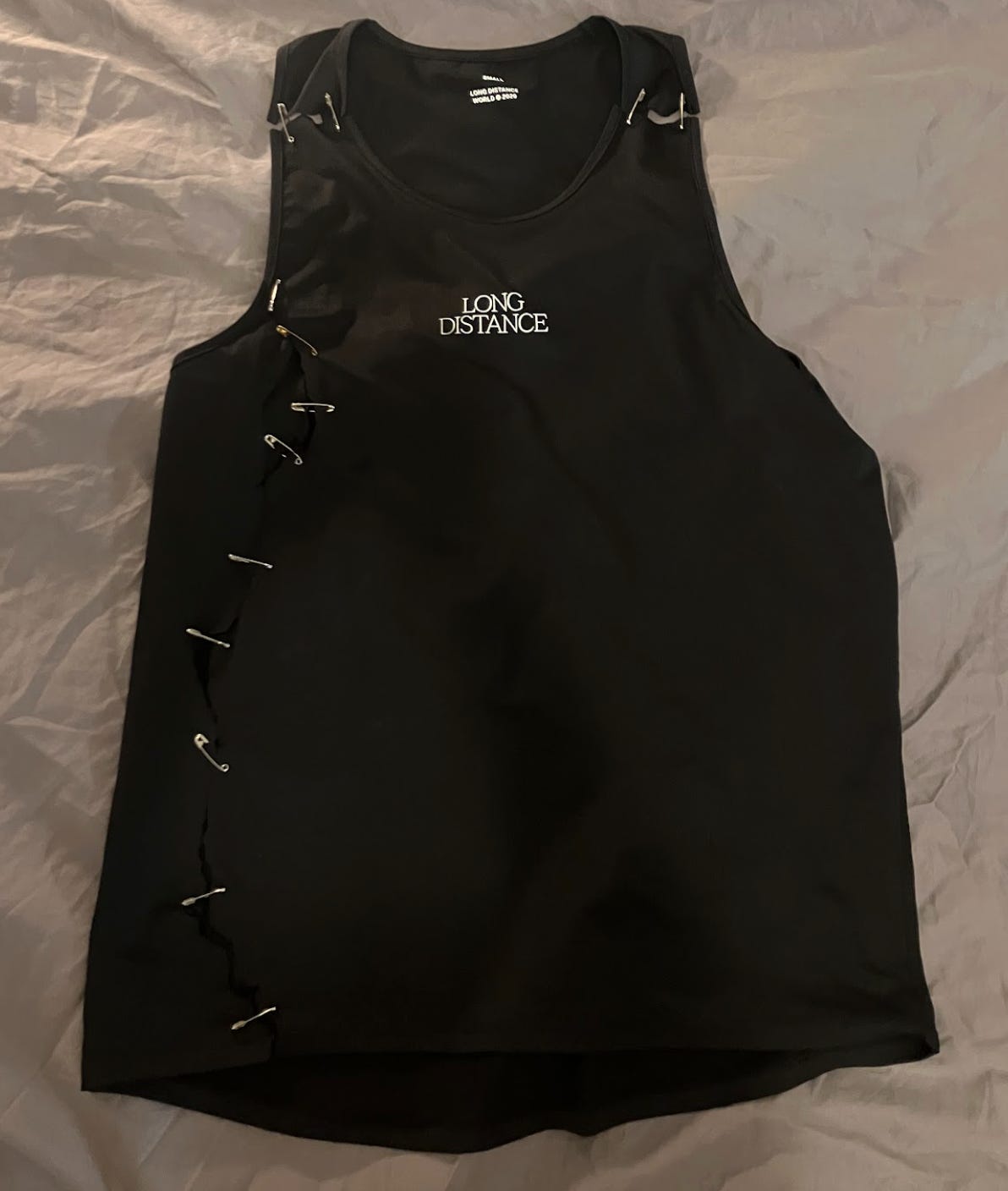
In the days leading up to the race, 2741 had pontificated all of this to their friends who could bear to listen. He had spent the week of anxiously checking the weather and studying the course map, rejoicing at the forecast of a tailwind and imagining each climb. He was decked out in a minimalist black singlet, a pair of 4” Tracksmith shorts, and a pair of carbon-plated super shoes he’d bought for his first marathon some months ago. He was ready to rip it.
At the start line the sun had not yet risen. The atmosphere, actually, was especially purgatorial that morning. Rain showers the evening prior had deposited sheaves of fog that settled heavily over the boroughs. Exiting from the subway station you were greeted by a deep blue, the color of the pre-dawn filtered through hundreds of meters of clouds too close to Earth. Visibility was low and it was difficult to make out the signs and banners. Things looked, truthfully, like a ruined watercolor work, the doing of an amateur who had tried to paint the darkened crowds against the twilight but had made the classic mistake of the medium, which is to cause a bleed, perhaps because they’d painted too close to the boundary and became undone by an involuntary trembling of the wrist, or because they’d thought that portion of the canvas had dried up and that they could push forward, a misjudgment of premature expertise inducing a little calamity, in the grand scheme of things a predictable mistake on the path to mastery but in the moment a significant source of anguish nonetheless. The only lights punctuating this blur were the glow of streetlights above, the flashing of police cordons, and the pointless flickering of traffic lights on Eastern Ave.
2741 nearly did not start. Only with two minutes before the wave closed did he dash through the corrals and slot themselves in place. The near-fatal mistake was a nervous bladder and a gross underestimation of the length of the porta-potty lines, the combination of these facts producing a rather embarrassing scene where he ended up sheepishly pointing at his Wave 1 bib and mumbling apologies while cutting the queue, in which he had already stood for a greater period of time than it had taken to commute from Manhattan to the start. Now with the most stressful challenge of the day conquered, he could take off.
An examination of the timing data at a more granular level of detail begets a clearer story. The 5K split times, through 20K, were 20:37, 20:43, 21:02, and 21:59. A difference of one and a half minutes over five kilometers, or a drop in pace of twenty-five seconds per mile, is common enough. Slowing down as the race progresses is natural for most as fatigue builds up. But for a runner like 2741, for whom a racing strategy typically includes a plan to run negative splits, this was a cataclysmic indication. With a steadily declining pace and especially gargantuan drop in speed over the last 5K, something had gone wrong. But with only a kilometer and change to go, there were only a few more minutes of holding on.
A few of 2741’s friends had been tracking him online, seeing these updates publish live. The end was very near. They saw the pin advance on the map, inching west through Central Park, until it hit the finish line. 0.01 miles to go, the tracker said, and just under 1:30 elapsed. A little strange that the finish proper hadn’t registered, but given the scale of the event it was probably a triviality, a technology glitch.
Only a couple minutes later a friend of 2741’s crossed the line. They had kept up a comfortable pace, but couldn’t help but notice a good number of runners suffering in the humidity in the final miles, stretching at the sides, taking walking breaks. At the race exit around Columbus Circle they went to find 2741, as previously planned, but he was nowhere to be seen. Calls went to voicemail and texts were not returned. Again a little strange. 2741 was typically a chatterbox. Probably he’d misplaced his phone or hadn’t gotten to bag pickup yet. Anyway, no matter; there were other runners to meet and cheer. By 9 AM there remained only a lingering concern surrounding the whereabouts of 2741.
Footage confirms that 2741 did indeed run the race. A YouTuber’s livestream shows him rushing north on 7th Ave through Times Square, looking strong, if not for one revealing cue: a tilted and leant-back head, often the first part of a runner’s form to deteriorate when exhaustion hits. In fact, if you could look closer, you’d discover an uglier sight. We can do just that, since NYRR hires race photographers from MarathonFoto to take snapshots along the course with which to upsell runners. Luckily for us, we can access low-res and watermarked previews of the photos without having to shell out any money, which in our case more than suffices, for we do not need many pixels to get the vibe.
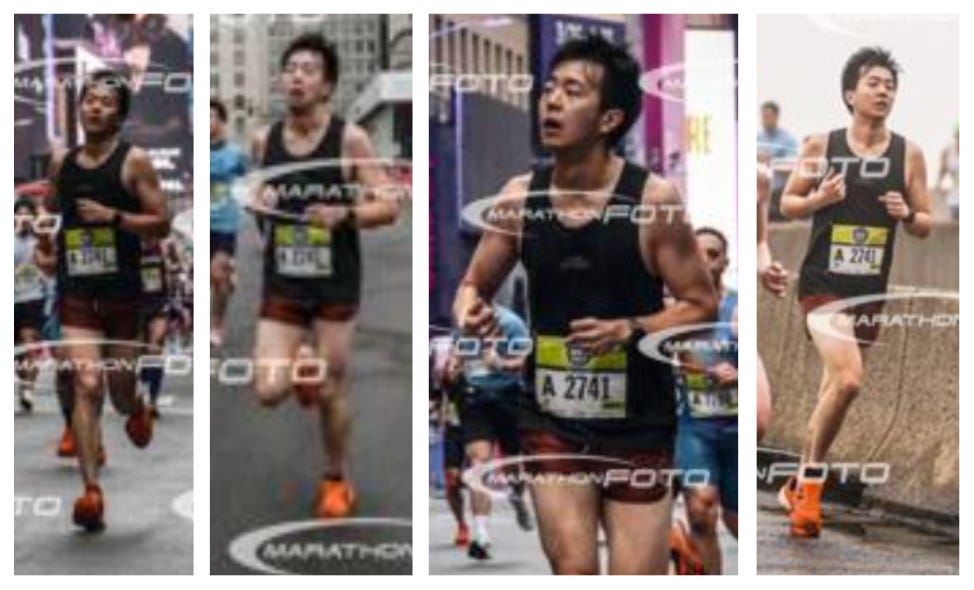
In these photos, I guess, he still looks heroic enough, mid-stride, breathing hard, locked in—though the hair is a tangled mess from the sweat, and the blankness on his face suggests someone who is only half there.
A volunteer taking photos around Central Park also captured this:
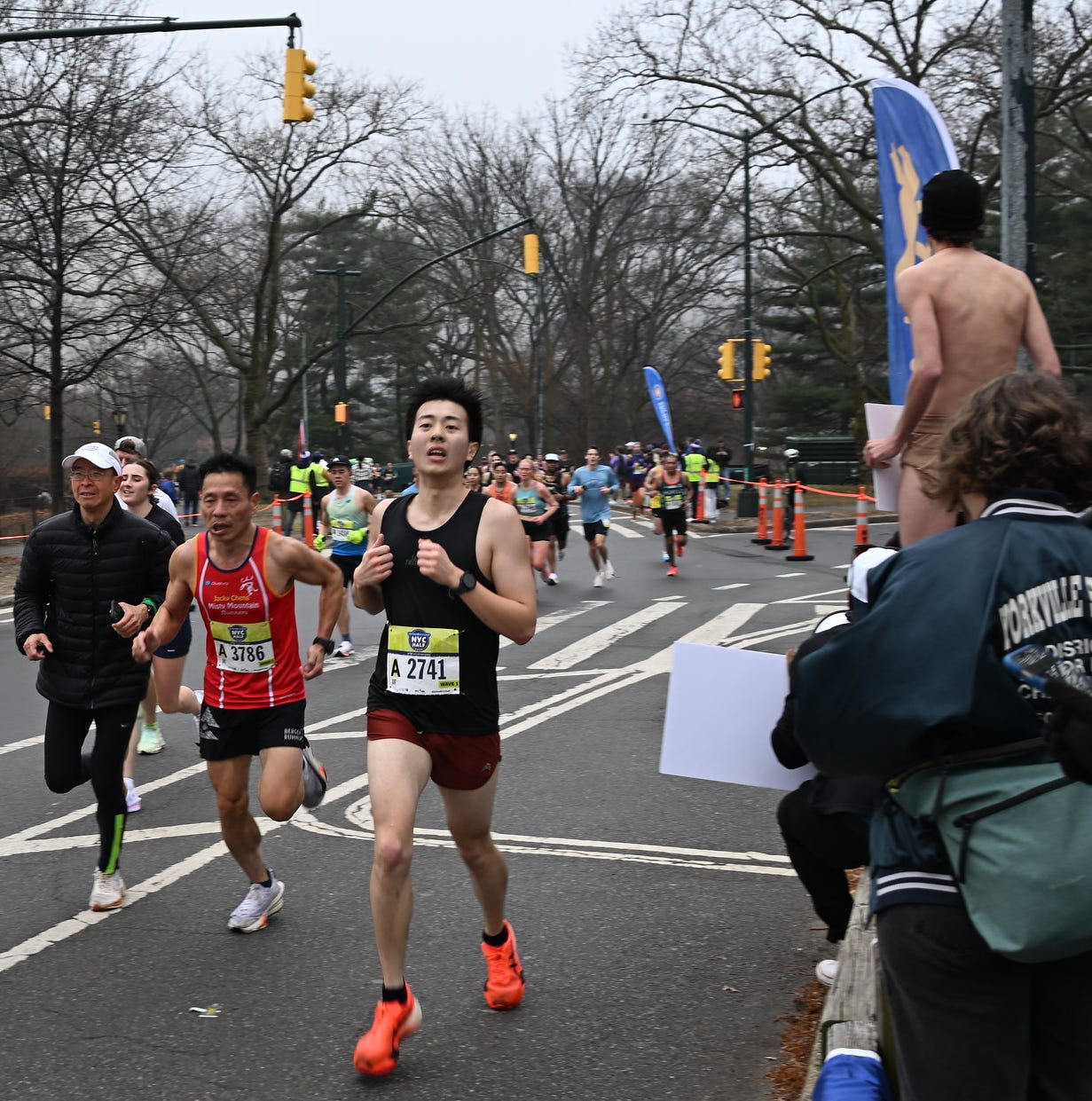
although the most intriguing sight here would probably not be the recoiling gasp printed on 2741’s face but rather the spectator to the right. He was holding a poster, for the record, that said “run faster or I drop the sign”.
Then there are photos like this:
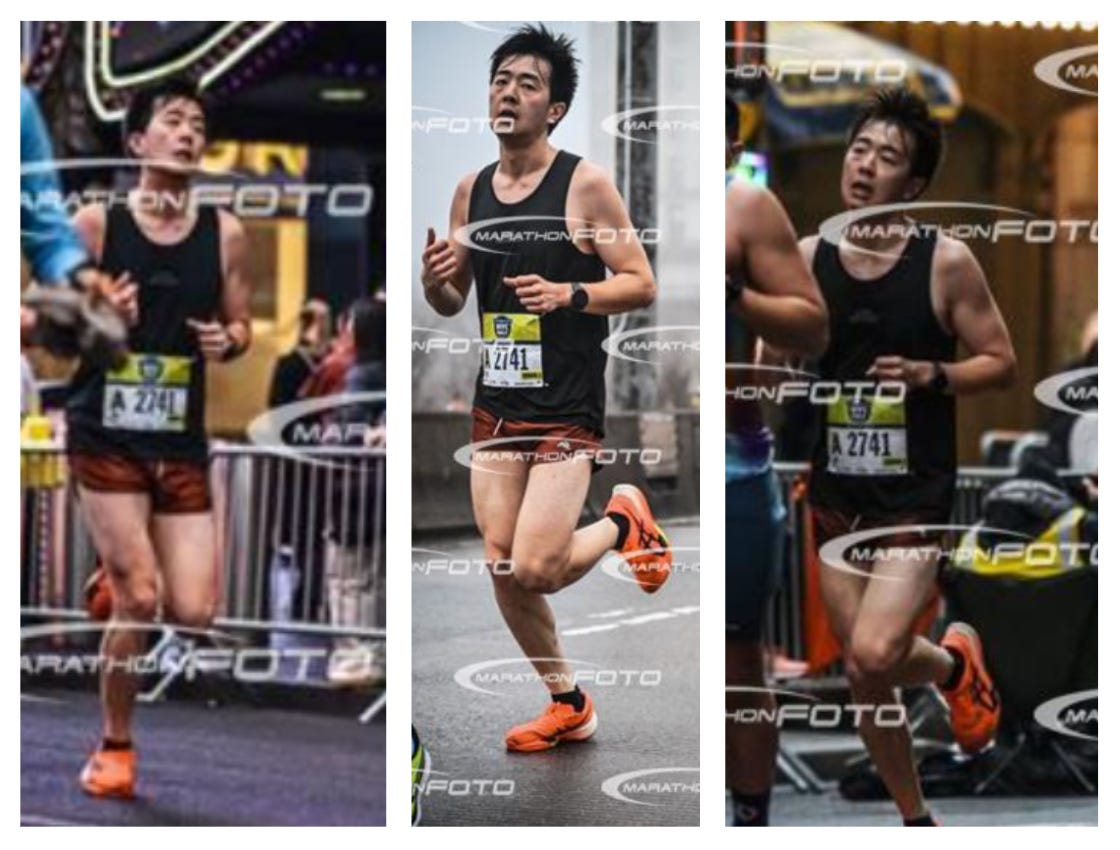
for which the best description might be “shell-shocked”. It goes without saying that 2741 got the max-effort race he was vying for. Who knew he would look so hideous doing it, though?
Conspicuously, no photos exist of 2741 crossing the finish line. He had been tracked all the way through except for the very last section. Given the evidence above, only one logical explanation remains, one that reveals a foreboding implication. 2741 DNF’d—did not finish. And if 2741 had been maintaining a fairly steady pace before disappearing without explanation, the circumstances surrounding this DNF must have been catastrophic, to a serious enough degree that he could not even have walked or crawled over the finish, could not retrieve his belongings after, could not contact his friends.
Here is what happened. Over the race, 2741 had been sustaining a high degree of intensity for his fitness level, generating significant amounts of body heat. The fog meant that relative humidity was close to 100%, so almost none of the sweat that he produced evaporated over the course of the race, which in effect incapacitated one of the body’s most crucial thermoregulatory mechanisms. The fact that the air temperature itself was not that high, coupled with the fact that 2741 was maintaining a pace meant to be highly uncomfortable, led to an especially dangerous situation. He was overheating without noticing it.
At approximately the 12.6 mile mark of the NYC Half, a half mile from the finish, the effects of heatstroke hit a critical level. His core temperature had risen to 108 degrees Fahrenheit. His vision, already shaky, blurred and his consciousness clouded. He became confused, ran sideways into the fences, slowed to a jog. He vomited and then collapsed, unconscious.

It is impossible to describe nothingness. The immediacy of this observation arises by definition. Absent the abstruse, everything we describe is rooted in some level of sentient observation, depends on us being alive and feeling objects. Take that away and words and thoughts will fail. Even stranger still is the process of drifting back into consciousness, of becoming again.
Indeed, nothingness is an absurd concept. Nothing, and only nothing, can experience non-existence. It does not make sense to experience true nothingness, as such a proposition would be fundamentally predicated on the existence of some entity capable of experiencing, predicated on the fact that there is such a thing as experience, conditions that cannot hold when there is nothing. In other words, it does not make sense to witness nothingness because in nothingness there are no witnesses. You cannot witness nothingness because in nothingness there is no you. The mere idea of nothingness is paradoxical, self-defeating, can only be imagined after it has ceased to be, like a fleeting afterthought. You can only conceive of absence in a universe of presence. Nothingness is a purely post-hoc phenomenon.
Emerging from this nothingness, you can imagine my confusion. The insistence of a reality to appear contra nothing, it seemed, was sufficient to justify its creation. Like a light switch flipping itself, off to on. All this was still beyond me. In fact, there was no conception of myself proper, let alone memory, perception, or reasoning. The only thing that was present was a vague state of awareness, far from recognition or perception. There was an awareness of some sort of ordered progression, some crude form of what we call time, such that events would happen one after another. Then there was an awareness of some residual emptiness, a remaining void, no longer true nothingness since it could be sensed, but still largely beyond comprehension, without such a notion as sight. It was a vast and claustrophobic expanse, of infinite and zero space since space was an ill-defined concept, its color the absence of color.
The ascent up the epistemological staircase followed. Almost immediately—though “immediately” is hard to qualify—the awareness became aware of its own existence, it became aware that there was some source and cause of the awareness, that this source was a self, that these tenets laid the foundation for consciousness, that the ability of this awareness to reflect and introspect formed a foundation for what is called thinking, and that that self was “me”. Identity materialized. Having reached the cogito ergo sum phase, I was suddenly overcome by a feeling of great triumph and satisfaction, of pride. I must have been terribly clever for having summoned myself from nothingness. Or something else must have been terribly charitable for doing it for me. More importantly, I realized that I had set out on a path to attaining the miracle of consciousness, a journey towards reality that I knew somehow would not be reversed. No matter that the full scope of what that entailed was yet to be determined. I grasped, in a way beyond reason, that it would be okay.
Now I just had to tolerate the eternal present.
The first sense to return is pain. First, the pain of breathlessness, the pain of having the wind knocked out of you, of holding your breath too long underwater. It feels as if I have surfaced, Matrix-style, from a thick amniotic fluid, suddenly learning the need for oxygen, learning that I have a mouth and lungs that are pleading for it. Then a surge of pain as my limbs materialize, bringing with them an intense, pulsing soreness. And a deep coldness surrounding the parts of myself I can feel, the bite of ice alerting me to the other parts of my body—my hands, the fingers extruding from them, my feet, my torso, my groin, my face. I become vaguely aware that I am a human, which is a kind of small but populous physical entity in the universe. The emptiness changes again, reduces itself furthermore to a shifting darkness, which I realize is because my eyes are closed. I open them, but I only see patches of light, forms lacking structure. I try to listen, but only hear a blend of voices producing incoherent syllables. I do not know where I am but can tell that I am lying down, or floating, in a way. I try to move my legs but the voices react disagreeably, so I stop. I feel wires crossing my face, something filling up my mouth. Who knew that coming back to life would be so brutal, so terrifying?
While my senses reintroduce themselves, so, too, do core parts of my memory. Picking up on these recollections is not unlike trying to tune into a radio station barely out of range, with bits of recognition flashing through white noise. Many of the contents of these recollections I do not comprehend, but take as true and well-formed with blind faith. I remember I have a name, which is Eric, and that I live somewhere called New York City, because humans have names and live in places. I remember that I spend lots of time sitting at a desk looking at large screens with words and numbers on them, which means that I am smart. I remember I speak English, a language whose constituent details are gradually returning to me. I perceive that I am drifting in and out of consciousness, that this is highly unusual for humans to do, and likely means danger. Oh fuck. I begin to panic, search for more facts and images in hopes that that keeps me awake, will help me reclaim my mental and physical faculties, stave off oblivion. I try to shout important words and statements I know about myself, in case it helps save my life, but my mouth has not yet learned to piece together sentences, so instead I blurt out phrases like “Eric” and “New York” and “holy shit”.
I feel my body shaking, and cannot tell if it is because I am shivering or because I am being moved. I see a bright light in the distance—a sky, filled with skyscrapers. Did I have a stroke? How did I fuck myself up? I recall stories of athletes crippled, rendered quadriplegic from injury. Have I fucked up the rest of my life? A voice asks if I know where I am. Another memory flickers into my mind—the Prospect Park drive. Did I get hit by a car while riding my bike? That happens to people all the time. I say “Brooklyn” and the voice says “okay”. I guess that’s wrong. Did I have a stroke? My parents must be pissed. Reality remains abstract enough that I’m not convinced this isn’t totally inside of my head. Maybe this is just a bad dream I can will myself to wake up from. I do sometimes get sleep paralysis after all. Maybe I can will the pain away. I try that. Three, two, one, wake up. Nothing happens. So much for willpower. I am not asleep and struggling to wake up, I am struggling to break out of a waking sleep.
A woman in white manifests to my left, and I concentrate on her. If I can stare, prove that I can control my eyes, that’s one small step towards recovery. The sensory clutter subsides, and I can hear her talking clearly. “You were running a race. You passed out and had a bad fall. We’re going to take care of you, okay? You’ll be alright.” Yes. I’ll be alright. I nod my head. I can see other people close by, but they seem like they’re chatting, laughing, joking. I must really be alright, then, if they have stopped caring about me. Washed over by relief, I surrender, knowing that I am falling into only a deep slumber.
Spring is a violent season. The stillness of winter is broken by zephyrs and storms brought by warm currents from the south. Organic matter breaks through the ground, calls loudly to mate. Revellers of Dionysus venerated spring’s raw, chaotic power; T. S. Eliot’s “cruellest month” is April, a time of breeding, stirring, “mixing / Memory and desire”; Stravinsky’s primitive and barbarous orchestration depicts a pagan sacrifice in his Rite. In retrospect, it may have done me well to be more superstitious. Beware the Ides of March indeed.
After fainting half a mile from the finish, 2741 was found and transported by volunteers to the medical tent. Fortunately, he was somehow able to break his fall in some way, as he arrived only with scrapes on his legs. A good samaritan must have stopped his fitness watch, as 2741 would later find on file a recording of the 12.6 miles he had already run. Presenting with symptoms of heatstroke, 2741’s singlet and shorts were cut and removed, and he was immersed in an ice bath prepared for this very scenario. It seemed, however, that 2741’s body had lost its ability to thermoregulate, for not soon after he became hypothermic. As he was still unconscious, NYRR staff made the call to send him via ambulance to the hospital for fluid transfusions and continued monitoring. Each runner is meant to write emergency contact information on the back of their bib; however, 2741 had forgotten to do this, such that volunteers were unable to immediately identify that 2741 was me.
Thus it was only at Mt. Sinai Hospital, two blocks from Columbus Circle, that I woke up fully aware, around two hours after I passed out, as a John Doe patient. I was in a hospital bed under the embrace of a puffy heated blanket and the beeping of an ECG. There were various tubes coming out of my arms and electrode stickers on my torso. I was wearing a slightly bloodied gown. My nurse answered my disoriented questioning empathetically and cheekily. I was a routine case. Blood testing revealed creatine kinase levels in the high hundreds, indicative of moderate muscle damage, but luckily far from rhabdomyolysis. Two IV bags later I was discharged in the late afternoon, shuffling away on petrified legs. NYRR staff had tracked down my registration and reached out appropriately, from which word-of-mouth had enabled my roommate to kindly retrieve my belongings. Checking my phone I saw a half dozen messages of a form like “congratulations on finishing”, and then, an hour or so later, “I hope you are okay”. I slept thirteen hours that night and for the next week any slight bend of the knee would induce a sharp flaming pain in my quads.
There is a certain venerable, if dubious, beauty about the DNF. It is a very raw, bona fide—platonic, even—version of failure: you had a very simple objective, and did not achieve it. You can come up with excuses of varying degrees of legitimacy but the bottom line is uncontroversial and non-negotiable. You didn’t make it. Your body could not keep going and the primary person responsible is yourself. Consequently it is a forced lesson in humility, where the only sensible reaction is to be gracious in defeat. For experienced runners, especially those racing the ultramarathon distances, it is a common enough occurrence that it has become a trope, almost a rite of passage. And it happens to everyone, especially the pros. I think of Daniel Do Nascimento’s stunning collapse in the 2022 NYC Marathon after running 21 miles at world-record pace; of Jonny Brownlee being carried over the line by his brother; of Eliud Kipchoge pulling the plug at the Olympics; of Jim Walmsley quietly exiting the 2024 UTMB, a race he won the year prior.
A DNF indicates that an athlete have taken their body as far as it can take them, which itself commands respect—it is a indisputably risky act that few people ever dare to try. In some cases, the athlete, having reached their literal physical limit, swallows their pride and concedes, a decision that requires considerable maturity in the heat of the moment. In others, they push themselves past the breaking point, fly like Icarus too close to the sun, and come crashing down tremendously, a sobering reminder that we are fallible machines.
In the aftermath of a DNF, confidence tanks and regret spikes. You’ve heard it from Murakami first: after dropping out of the swim stage at a triathlon, he has written about the time it consequently took to return to form, to “get over the shock and regain [his] composure”. You take some clear losses: no official finish, no medal, no celebration. Personally, I also lost the clothes I was wearing, the extra energy gel I had not consumed, and the 9+1 credit I was hoping to get. And the complications I sustained from heatstroke meant that I have had to take a pause from exercise—a devastating blow to both my running fitness and running lifestyle, which is grounded in routine, momentum, and incremental, continuous improvement.
It’s also too easy, especially in my case, so close to the finish, to fall into the what-ifs. It was foggy, I don’t do well in humidity, and I sweat buckets—I should not have tried to PR with these conditions. I felt myself blowing up going through Times Square; I should have wisened up then, poured some water over myself, checked my form. If I had slowed down at the 12.5 mile mark even to a 9:00/mile pace I would still have gotten my sub-90. I don’t mind passing out but couldn’t I have done so after finishing?
None of this thinking is productive, as regretful reasoning generally is. In the wake of defeat I strive to be a contrarian instead, to consider the small wins. I set PRs in the 10K, 15K, 10 mile, and 20K distances. I was quickly saved by a team of prepared and well-equipped volunteers, for which I cannot express enough gratitude. (I also think now that NYRR events invite a bit of moral hazard, since you’ll almost certainly be taken care of should you push yourself too much.) That out of body experience was a firsthand encounter with spirituality, pretty cool, to say the least. I wanted to learn my limits and now I do, an essential if not excessive calibration step in my running journey, which, on the scale of my lifetime, is hopefully still getting started. To race hard is, à la Mishima, to worship and immolate your physicality, to seek out and confront your own annihilation; by that metric, the NYC Half was a resounding success for me. And with a new chip on my shoulder, I have a reason to race it again, to envision and actualize a triumphant return.
Actually, if you had looked at the NYRR race website on race day, my last official tracked time—snapped by my timing chip when medical volunteers presumably carried me over the finish en route to the medical tent, before my race log was revised to be a DNF—was 1:29:24. Maybe I did win.