
The Other Side of Race Day
scenes of the NYC Marathon

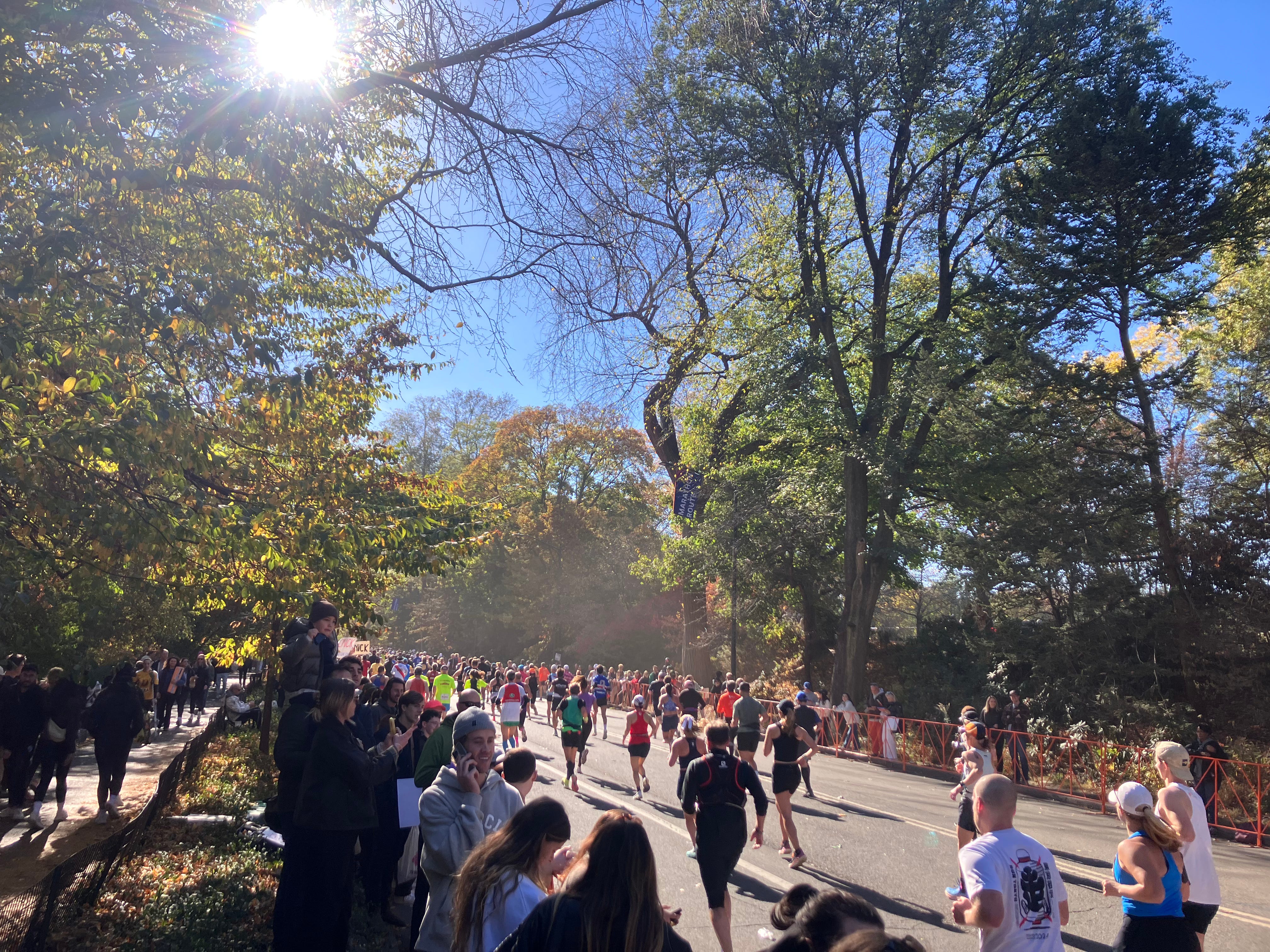
It is the first Sunday of November, which means that it is the best day of the year. The marathon is back.
The professional women fly out of Staten Island at 8:35, tearing over the Narrows in that spotless and streamlined cluster shape which characterizes the elites. It’s still early: the vast majority of runners remain huddled at the starting reservoir, awaiting their wave in the hours that follow. During their ruthless cruise up 4th Avenue, I find myself on the 3 below the East River, zealous to do some sightseeing myself. In the train there are already telltale signs of what’s to come: rolled-up signs held in gloved hands for a long and frosty morning, stadium horns poking out of bags, and a persistent restrained murmuring: I wonder if we’ll see Obiri… I’m gonna sign up for a 10K, I’m so inspired… she’s trying to BQ, which is just insane for this race ‘cause it’s hilly, you know.
I depart from Borough Hall around 9, about a kilometer away from the course, which ricochets past downtown Brooklyn. I could get off closer, but I’m aiming to get some miles in myself today, and I figure the jog down Fulton is scenic enough. Conditions, anyway, couldn’t be better: sunny, chilly, low wind. The traffic this Sunday morning is subdued and even quieter than usual, almost muted. It doesn’t take long before I spot the impromptu barricades of blue tape and utility vehicles.
I have some time to spare before the lead pack passes, and, keen to keep myself warm and entertained, I spend it following the route through Fort Greene. As is the case with most Big City Marathons™, there’s a calm before the storm as handcycle and wheelchair racers, the first to have left, trickle down the road. The crowds here are more sensible than in Manhattan, and have not yet assembled in full force. The consequence is that the cheering, unlike the wall of sound that the runners will experience, is still isolated, almost anticipatory, and gives you the opportunity to take in the other sounds of the stirring city. Kids shout out to advertise cookie stands. Overstimulated dogs of assorted varieties bark. Boomboxes blast OutKast and Taylor Swift. Some lunatic is playing the bagpipes. And again, the murmuring. This is the drone of the city, the hum of its weekend metabolism, but concentrated and magnified along these particular roads today. This is the static in the air.
It’s 9:23 when the hype precipitates in Clinton Hill. We are addressed by an elaborate and almost ceremonial buildup of motorcycles, police cars, some more motorcycles, a couple cyclists for good measure, and then the timing truck with a trove of news cameras mounted. That’s the Big City Marathon™ decorum that makes sure you can’t miss the spotlight. Finally the elite women glide by, eliciting the first true hurrah from the burgeoning audience. Minutes or hours of anticipation, and an elaborate motorcade to boot, over in thirty seconds. If all you wanted to see was one pro, you’d be getting an appalling ROI for your time; watching a road race can be underwhelming that way. That is a plainly incorrect strategy. A far better approach is to look forward to the fifty thousand marathoners yet to see, and more importantly, soak in that vibe.
The elite men started at 9:05, a half hour after the women, which gives me some more time to kill. I’m aiming to meet a friend in Williamsburg, so I continue my trek along the route on Bedford Avenue. The neighborhoods in between are far less busy, populated mostly by Hebrew advertisements, hassidim going about their Sunday mornings, and a cheer squad of Puerto Ricans that has strategically positioned themselves around a bend for maximum exposure. Passing by the Williamsburg Bridge brings a sea change as upscale coffee shops, freshly-painted bike lanes, and sans-serif fonts sprout from store windows. I meander from one small world to another.
Shortly after 10, just south of the L, the elite men, announced by a similar procession, pass. The difference this time is that eleven miles in, the lead pack has shaken off some athletes who trail behind in a way reminiscent of a comet shedding its disintegrating tail. The break in the stream of athletes is smaller this time, as the semi-elites and club racers closely follow. Now comes a downpour of bodies—this is a good time to stay put. The first runners here, the really serious ones, zip by in twos and threes, fiercely repping their club kits—CPTC, BKTC, Dashing Whippets. Then the volume abruptly doubles and then triples, shooting up the inevitable slope of the bell curve. Now the cheering is frenetic, a waterfall’s sustained roar that completely masks the pitter-patter of carbon fiber and foam on pavement. A man beside me with a temple fade quips to me that his Apple watch detects abnormally high sound levels.
With the arrival of the fastest pacers, sustaining a blistering 3-hour pace (and thus pulling along a horde of Boston hopefuls), the race volume hits its maximum capacity. The road becomes a fluctuating canvas of blurs from neon supershoes, bib numbers, and pastel singlets. With its speed, the first wave is evocative of the sputtering of a turgid hose. Not just figuratively: the road narrows after a fluid station here, so the spilled Gatorade and mass of discarded cups flung aside and flattened underfoot quickly clog the curbs. Fortunately for us, cleanup will be a hapless volunteer’s problem.
The torrent of runners here is the main attraction, and will continue for hours as tens of thousands rush by. For us it is a parade of chaotic elegance. Yet a more conscientious marathoner, should they somehow be able to look past their pain, would realize that the masses lining the boroughs form their own twenty-six mile festival of sorts. Sponsor tents line the streets, handing out signs, bells, and samples of nutritional supplement. Run clubs have spray-painted the streets. Confetti guns shoot indiscriminately, and from afar it appears like a fog has suddenly manifested. Fans compete for attention, whether that be through showing off witty posters (“you run better than the MTA”… “brat runner”… “remember you paid for this”… “I am hungover”) or by simply seeing who can be the loudest. A little girl, raising her arm up to high-fiving level, yelps with delight when she gets one. The race is a dual parade where each individual simultaneously plays both the performer and audience.
Spectators now brim against the course. Fans balance tiptoe on benches, outgrown tree roots, fire hydrants, anything really, in search for optimal viewpoints and Instagram story shots. Crossing remains permitted at an intersection, and this occurs sporadically to various degrees of success. Someone takes advantage of a two-second gap to dash across; a group of teens is not as nimble, breaks a runner’s stride, and are cussed at for the split second that they are within earshot. As the crowds swell, so do the crossings. The police officers on our side of the road bring more fences to cordon off the intersection, but the officer opposite us fails to reciprocate, which only compounds the problem. The officers on our side yell but struggle to beat the noise. I am reminded of the traffic cone scene from Toy Story 2.
Escaping through the side streets, I’m taken aback at how quiet it is. One block away, the noise is faint and dreamlike; it seems like time is slower, the air stiller, the day preserved in suspended animation. A boy wearing a beanie and headphones cruises down an empty road on his longboard, whose abrasive echo reverberates off the brick walls. Above the East River, the J and M complain as loudly as ever.
By the time I get to the foot of the Queensboro bridge just before noon, the elites have all but finished. But these marathoners, spilling down the bridge ramp and surging through the sweeping left turn onto First Avenue, have ten miles to go. The downhill here provides the perfect vantage point, which to my chagrin makes this one of the most popular sightseeing spots. The crowds here are piled three to four deep behind the fences, and I think the people I’ve been trying to track have already passed this point. No good. Nevertheless, it is too easy and too fun to soak up the mood. Words—from runner to runner, runner to spectator, spectator to spectator—are exchanged on the fly, tersely, caught up in the action. Someone spots their face, blown up and printed on a stick, and backtracks a precious fifty meters to receive an invaluable hug. Behind her is a man, face and torso tomato-red, who stops to take a breather. Those beside him, as if on cue, immediately start egging him on until he lurches away and continues.
These transient interactions happen continuously, automatically, naturally. They can be large—say, the extravaganza of a well-established run club's station, commanding attention with bells and banners and cameras—but most are small, atomic, maybe an accidental flash of eye contact or a spontaneously-directed yell. They are largely anonymous, the parties chosen by chance, identified by maybe a bib number and a cardboard sign. Yet they feel completely instinctive. For today, we feel like we actually see each other, to the extent that we can do so in a split second. On marathon day, the opaque and quotidian curtains which separate us—the sensory vacuums of a phone screen and noise-cancelling earphones, the temporal constraints (or excuses) of having something to get to, the general social reticence of the commuting New Yorker—are made translucent. Here is an invigorating change of pace inviting us to forget about the protocol, to limit our barriers to those of the course, to recall that having a good time is what keeps most of us running in the first place, to be able to move and yell and play as children might, even as we know there are good reasons why we cannot always live this way. We will not cherish this simpler bliss tomorrow, but at least we have the privilege to do so in this vanishing now, to pause the complexities and feel the sweat and sound and joy, to flow.
That said, of course there are snags. I travel to three separate spots to try to spot an acquaintance and miss him each time. To cheer someone you know is in reality a quite stressful process: it’s one thing to parse a flood of faces for one you recognize and another to get their attention, and although tracker apps have helped with getting the timing right, they serve little use when your cell service is getting throttled to death. I later find out that some friends were watching at the same time but a different place, and others the same place but a different time; it seems that today is a day of missed connections more than anything.
In the afternoon, I watch as the marathon darts into Central Park, crosses mile 24, and descends Cat Hill in the glistening sun. I see the plodding of runners, clad in orange thermal blankets and barely aware of the medals around their necks, being herded through arduously long exit zones. I pass lines of finishers who, having spent the entire morning obsessing over time, gladly relinquish their concerns about it as they queue for Italian restaurants and medal engraving booths. Some aimlessly revel in the stew of people spilling out onto Columbus Avenue. Others quickly reunite with their families and partners and cliques and waddle off. A few unceremoniously slip down subway staircases to commute home alone. A man sporting Oakleys, Alphaflys and a thermal blanket threads the traffic on an electric CitiBike.
In the evening, some spirited racers stay behind well into the dark to magnanimously welcome the last finishers. Running brands on Instagram begin to spin the content creation flywheel, churning out a stew of swiftly-assembled montages, influencer vlogs, and photo compilations of their Nolita pop-up stores with plenty of superficial philosophizing to boot. Nike, which has just mounted an advertising blitzkreig of black slogans on orange billboards all over town, hosts an afterparty in Fidi, and by 8 PM the entrance line is three blocks long. The thuds of bass speakers and an electric orange glow leak onto the silent streets. That said, much of the city will sleep: it’s Sunday night, and there’s a long week ahead.
A Big City Marathon™ is both more and less than you expect it to be. The more-ness, I think I have already described. By less-ness, I don’t mean less-ness in the sense that to run this race, you really just suffer for a couple hours doing one thing and then cross a line, though the gravitas there can certainly also feel fleeting. Rather, I mean that to partake in it as participant and spectator alike is to exercise the wonderful and burdensome agency of constructing your own experience while also acknowledging the fact that said experience will never come close to capturing all that has been and all that you may hope to capture. As is typical in New York, there is always more upside that will evade you. How lovely it would be to see everyone out here, to share the euphoria of every single finish, to absorb all the spectacle. Unfortunately (or fortunately?) we are not omniscient, and, as with much of life already, have the duty to imbue our own narratives. Today is all of, and only as much as, as much or as little of one has made of it.
I won’t wax poetic here about the gruesome beauty and the meditative struggle and the transcendental love that goes into running, lest I add to an already oversaturated realm of writing. At the least, I’ll save that for those who actually completed the marathon this year. I could continue to suggest and reprise more themes and takeaways I personally derived from the day—how this race qua logistical miracle showcases that the city can actually get things done if they really want to, how people weren’t lying when they described the day as a city-wide block party, how the time seemed to both stand still and rush by—but then I’d be performing the futile job of trying to weave and prescribe a grander narrative. Part of the magic is that everyone will have their own stories to share. Today there were fifty-five thousand exceptional ones, out of millions more, written in the streets of the city. We raced, screamed, played, wept, and celebrated. We inspired and were inspired. Only 364 days until we can do it all again.
keep running and posting Eric, I’ll read every one of them!