
The Future Factory
notes on visits west

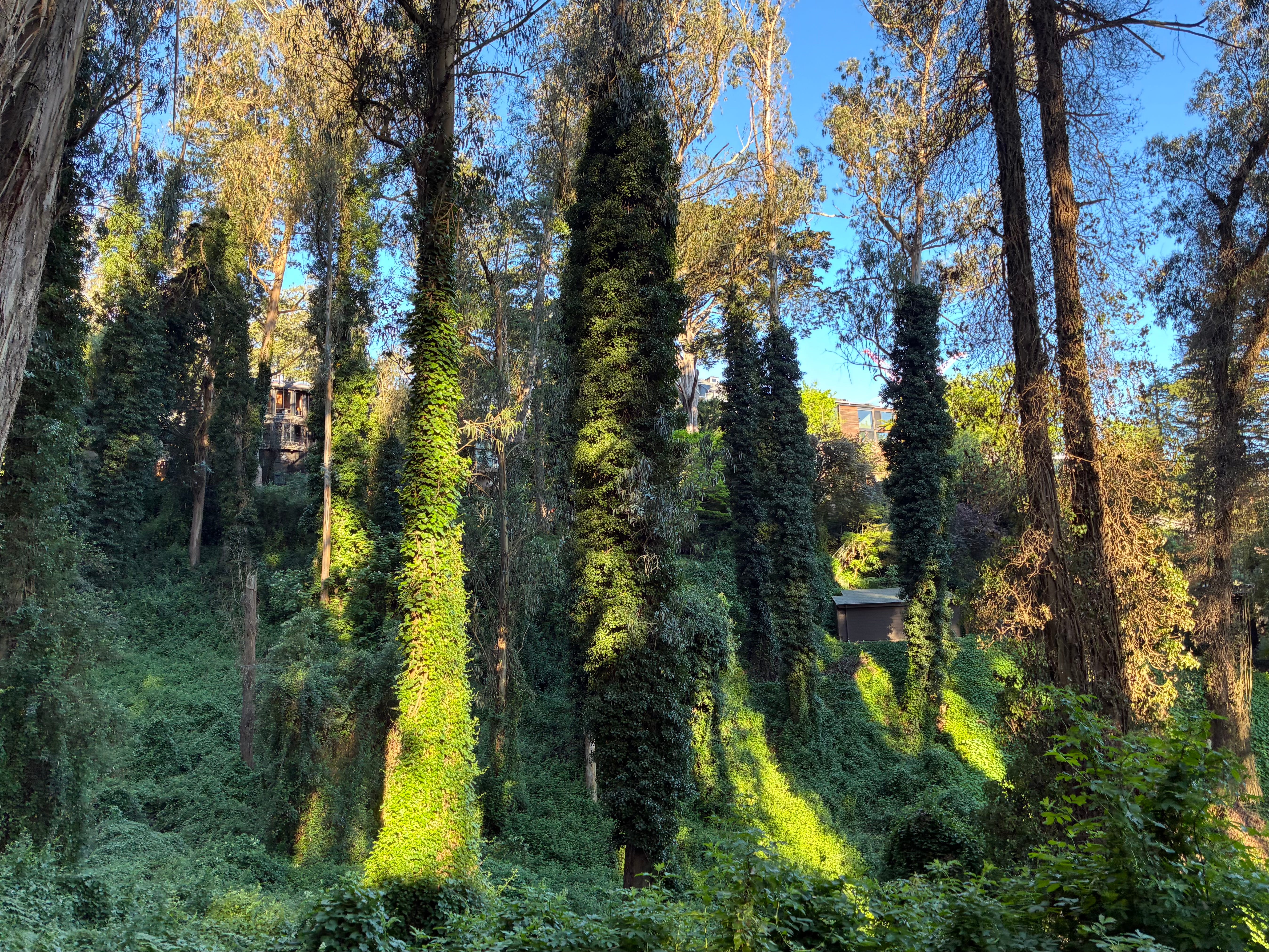
Six years ago I was miserable. As spring warmed to summer I gazed upon abundant blue skies and trees budding in chartreuse. Not long before then, I’d been hoping that these months would’ve also imparted a personal blossoming of sorts. I was looking forward to my high school graduation and the rare blank canvas that university would provide. I was going to escape these compulsive suburbs. I craved the coming-of-age tropes I thought I’d enjoy after years of grinding and the emotional stuntedness that accompanied it. I couldn’t wait to grow up.
It wasn’t surprising when our school board announced that classes would be suspended in March. By then, the numbers displayed on the case tracker websites had ceased to make sense. Humans can’t understand exponentials. At a thousand deaths you’re nervous about what could happen next, but at one hundred thousand you can no longer grasp the scale. Teachers scrambled to consolidate online learning setups as we realized we weren’t coming back. Nominally we were supposed to continue studying for exams, but once those were cancelled there was no point in pretending to care. I checked out and waited for the fall.
Halfway through the summer, I was invited to an abruptly-scheduled video seminar where I was told that, as a non-American citizen, I was not eligible for on-campus housing. In fact, because my student visa wasn’t active, by government policy I wouldn’t be able to enter the US. But frankly, they said, at this point there probably wasn’t anything better to do other than to go ahead and complete a virtual year.
I took their word. Soon leaves like gold foil plated the earth. Waves of chilly air swept them away and beckoned in months of frost and overcast. My friends moved out and began the rest of their lives. By the time a second spring rolled around I had grown listless to time. Days ground to a halt and seasons washed away. Months went absent from my camera roll. The cadence of a day was marked by Zoom chimes and grids of poorly-lit faces.
I took hard classes and binged TV. I learned to drive. I walked in forests by frozen ponds over snowy paths stamped with vanishing footprints. I got vaccinated. I replanted saplings and cut tulips. I worked on problem sets with the sound of rain as company. I got my license. I grew apprehensive. I felt bound down and stagnant as life passed by. I could just about hear the whistling of vanishing opportunities and the gloaming of faded hopes. I felt a gilded period slipping away, like my story had ended before it had started.
Yet it all passed. A year later I moved. I left for a new home, one of twin XL mattresses and foodslop serveries and the rushed footsteps of tardy underclassmen. Reflecting on the pandemic it is unmistakably true that I was immensely privileged. Nobody I knew was hospitalized by the virus, I could walk outside everyday, and I never worried about food, family, or health. But sentiments and disheartenings come from relative thinking, of obsessing over all that I wasn’t doing. So there’s a kind of vacuum in my memory, a stone I turn over in my head, this gap where I became intimately familiar with a pith of restlessness and trepidation.
I was talking about COVID-19, but those feelings I experienced haven’t been limited to the pandemic years. I’ve been experiencing them a fair bit lately, and they pulse strongest whenever I visit the beautiful, sunny hills of the San Francisco Bay Area.
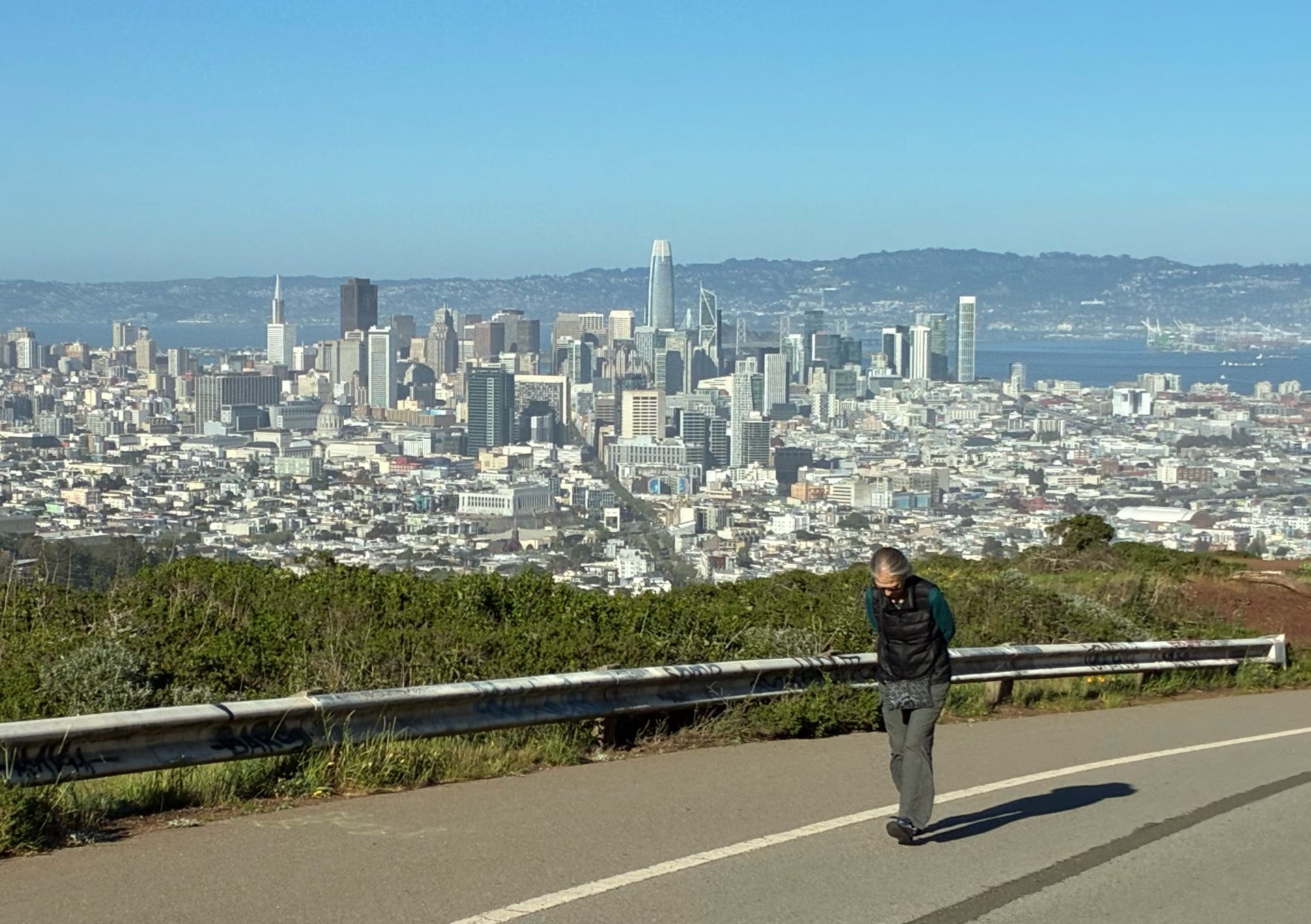
Oddly enough, I have not yet visited the Bay Area primarily for work. I like to say that I’m vacationing in the least vacation-y place in America. That said, it’s true, even if I’m bumming around, that every time I’m there I find myself learning. There is a buzz in the social fabric that pushes me to inquire more, inquire for more. And something about the sanguine sky frames a state of mind that’s slanted towards keen observation.
More than anything, I observe the land. Understanding it is key to understanding culture, as it lays a physical foundation for how people move, engage, come together, and come apart. Infrastructure, or the lack thereof, offers surprising insight into the character of a region.
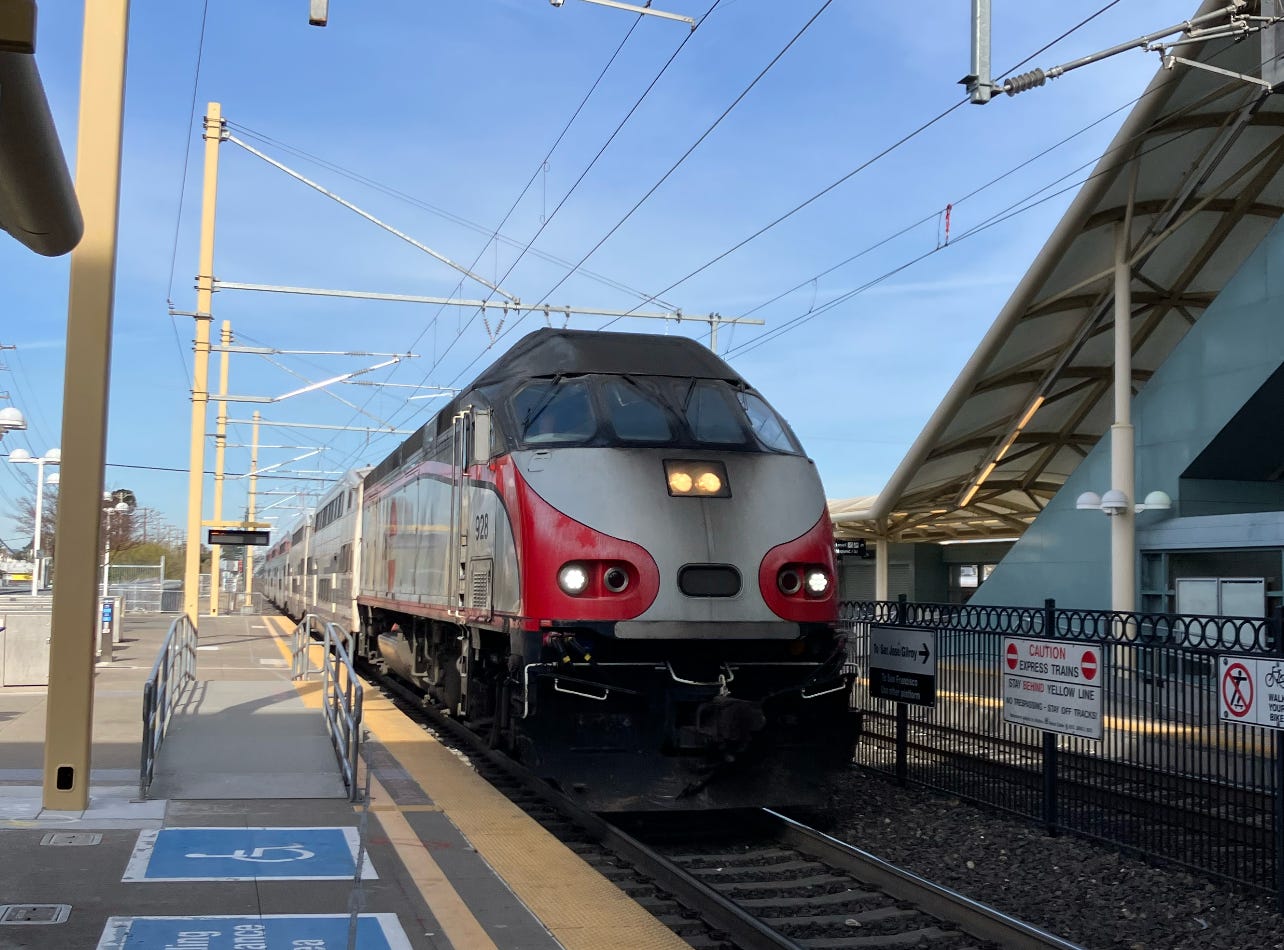
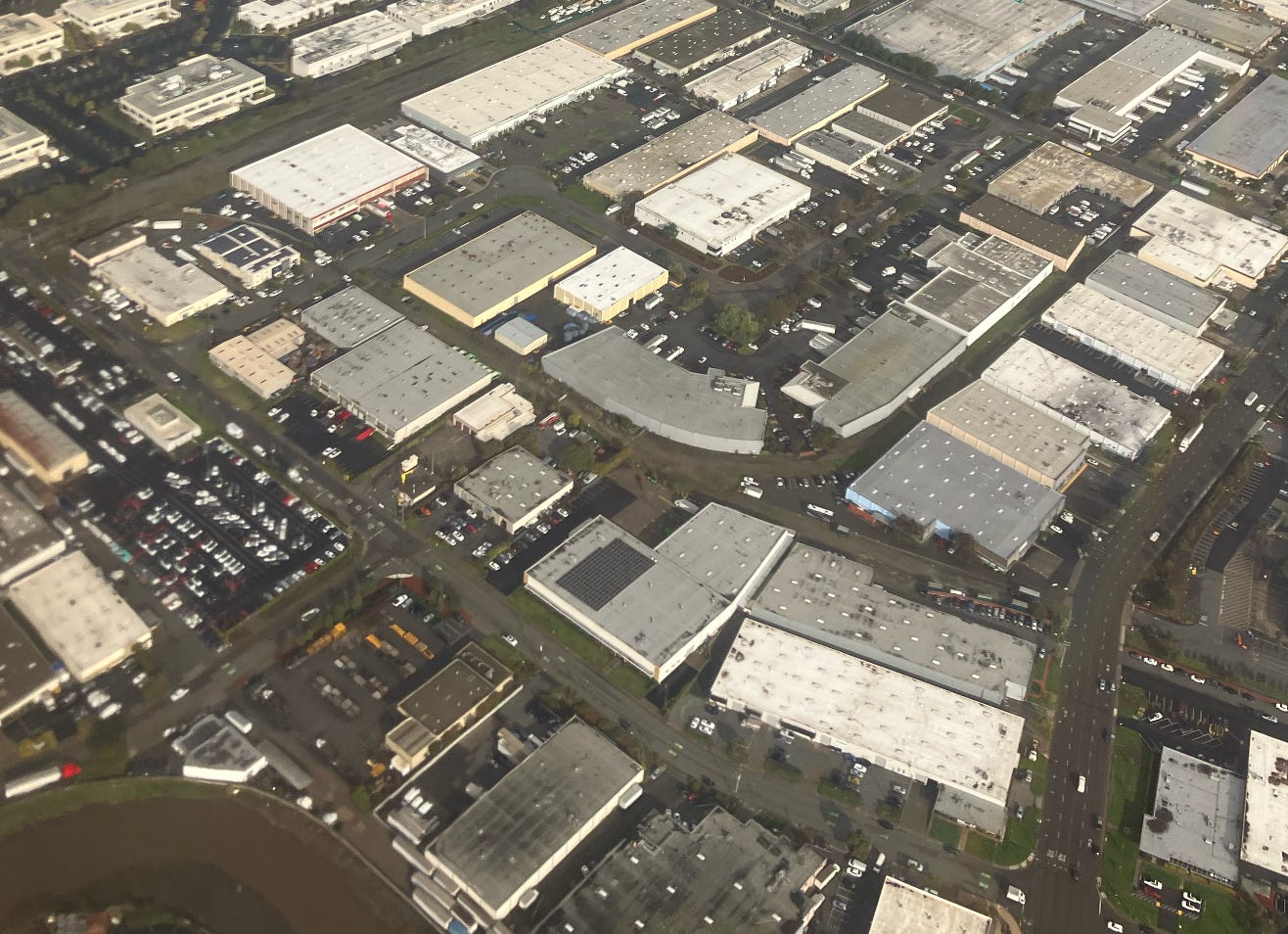
A commute on the Caltrain from San Francisco to San Jose provides a good survey of the Peninsula. This sole commuter rail line forms a double spine with the I-280 that anchors an axis of brilliant and voracious innovation. An hour-long trip passes through microclimates, literal and figurative, in a kind of reverse pathetic fallacy. Near the north terminus, a breeze by Dogpatch that carries off wisps of cortisol and adrenaline from the toiling of founders in open-office coworking spaces. Row homes creeping up the side of naked San Bruno. Fog rolling over the Santa Cruz range and settling among nestled estates of fuck-you money, where manors and trees lie translucent through the mist on land zoned exclusively for single-family housing. As the air warms in the south, freshly-paved stroads and panoramic parking lots filled with Teslas and SUVs abutting monolithic hyperscaler headquarters.
Getting around is grueling. Outside of the city, as is the case in nearly all American suburbs, there is no option other than driving. Either own a car or scrounge for a ride on the apps. Calling an Uber, Lyft, or Waymo sounds great on paper until it becomes a necessity that costs multiples of what a transit system would charge. It’s a disappointing utopia. No level of smooth UX or even autonomous magic can mask the frustration of living in a car-dependent sprawl. The MUNI and BART’s coverage is lacking, and their operations are crippled by a lack of consolidation, budget shortages, and glacial review processes. Other micro-mobility setups abound—e-bikes and scooters erratically scatter intersections around the city—but they struggle with steep grades. It seems that SF offers so many transit solutions because none of them work.
It’s all because of the hills. They distort distance, shard the neighborhoods, and extinguish mobility. The street grid is ridiculous, a stubborn net cast over the land that makes much of the city unwalkable. It was laid out for convenience and speed during the Gold Rush, when the city’s population grew by over two orders of magnitude in six years. Unlike Boston and New York, where hills were levelled and land was smoothed over the years as settlers expanded, in a rush for fortune there was no time for moderation. It was much easier to run over hills than to veer around them or to burrow under them.
After an earthquake in 1906 eviscerated over three-quarters of the city, that same grid was restored. Rather than redesign the street layout, reconstructors prioritized moving fast and kept things broken. In this way a map of SF is a testament, with its roads etched in obstinate lattice, to the founding days of the West, and the founding ethos that has remained in place since.
It’s not rational for homeowners to desire transit, or any public infrastructure for that matter. So much personal wealth has been driven into real estate that any initiatives that threaten the scarcity that keeps prices high amount to financial threats. At the core, NIMBYism is a self-preservation measure and a profitable investment strategy. It can lead to real aesthetic wins: with the razing of the Embarcadero and Central Freeways, SF has built net negative miles of highway in the past half-century, and in so doing has created some of its suavest neighborhoods. It also demonstrates a critical failure mode of the American individualism ideal: once you’ve got yours, the story is over. Look no further than at the perennial housing shortages and traffic jams to see how this mindset is optimized for producing coordination problems. A digital abundance has not translated remotely into the physical realm. Scant is the sliver of affluence from private enterprise that has trickled down to everyone else.
The Caltrain is one of the preeminent train lines in the entirety of California, and it likely will be until the state’s high-speed rail line is completed, which is to say that it will be for the indefinite future. But unlike the high-speed line, whose construction delays drag with them a ball and chain of bipartisan castigations and eminent domain quarrels, the ineptitudes of the Caltrain are comparatively overlooked. Proposals to electrify the line first arose in 1992, and in typical fashion were then shelved for twenty years. In 2015, after the project had received environmental clearance, the city of Atherton sued on the basis that electrification would require removing eighteen trees. Groundbreaking was delayed for a year and a half until the lawsuit was thrown out, at which point the first Trump administration froze previously-committed federal funds for another several months. Construction eventually began in 2017 and finished seven years later.
When the Caltrain’s electrification was first suggested, the SMS protocol hadn’t been invented and CDs had just overtaken cassettes; by the time diesel trains finally disappeared from SoMa, folks were talking to ChatGPT on their phones. Plans to extend the Caltrain to the Salesforce Transit Center, or to develop the land around Bayshore Station (weekday ridership 130), which presently borders an empty patch of land paralyzed by a saga of zoning battles, have also stood still for decades. Small wonder that builders seeking a shot at glory forgo the realm of tangible things.
Nowhere else is the gap between intellectual dynamism and material torpor so apparent than in this K-shaped landscape. But besides the litigation and bureaucracy, perhaps one of the other reasons that the Bay Area’s sclerotic public works have been overlooked is because infrastructure has never been at the top of one’s mind. Especially not now. Today there is only one topic cannibalizing the attention of every engineer and mogul alike, a rising tide as if the bay were swelling to submerge the land whole.
Lately there’s been a popular question going around the young tech circles, which is to say the lion’s share of all social circles, in SF: what will your post-AGI lifestyle be? When nobody needs to work anymore, when the potency of human intelligence becomes a rounding error compared to machine gods, and assuming (still rather controversially) that those gods don’t kill everyone, what will you do?
I joke with my friends that the true meaning of the question is simply asking what one’s merits are aside from their intellectual labor, and what one’s passions are outside of their career. Maybe that’s why folks in these circles have such a hard time answering it. Work, achievement, and affluence are so instrumental to their identity and so closely tied to their sense of worth that an existence without it is impossible to conceive. The whole premise of the question spurs an existential fear in the striver.
If there is still uncertainty around the technological singularity then it is not to be found in this city. The realization that the question is not if but when dawned decades ago in Berkeley. It fanned new sparks of fervor on Sand Hill Road years ago. It hangs like the fog over most of the Bay now. The signs seem clear. The capabilities of frontier models have advanced in leaps and bounds, faster than most could have fathomed. Scaling laws seem to prescribe exponentially more compute as the only key to unlocking further intelligence. Intelligence that can automate away knowledge work. The rest is denial. There’s a bitter aftertaste as researchers, engineers, and executives arrive at the natural conclusion: as always, those with the most speed and power will probably win. Macroeconomic sums of capital are deployed posthaste. Data centers rise and interstitch the Earth.
Among this blitz to scale is a twitching desperation among everyone who’s afraid of being “permanently underclassed”. The argument goes something like this: Digital superintelligence will render wide swathes of the economy obsolete and capture all the value that it’s automated away. Capital and labor will become fungible, so humans can be fully factored out of the economic engine. Once that happens, those that control that intelligence, and the industrial complex around its generation and distribution, will accumulate all of the money and influence in the world. Everyone else will languish in a state of virtual economic, political, and cultural serfdom. You’d better try to get your foot in the door and jump onto the ship before it sails. This is frontier psychology.
Fellowships and accelerators, so I’ve heard, have recently seen a great wave of applicants who seem poised to outright fake it until they make it. Before, grift was just an amoral tactic in the playbook to win. Now, if there is really only a year or two left to do something big before class calcifies, it seems necessary. This is the newest gold rush, but something more conclusive is at stake. Nobody understands the gold, and the gold might poison us all, but its value and allure are tangible beyond comprehension. Soon everything will be golden. Plated with layers of gold that cover all in a monochrome glistening sheen. Or maybe golden to the core, all substance transmutated alchemical into a cold absolute. Gold addictive and infectious like influenza. There is a race towards the Midas touch.
The gold mines here don’t feel subterranean. Quite the opposite. All this pursuit happens day after day amidst spotless skies and crisp air, weather so pristine that, were it not for the potency of AI psychosis, no resident would find it reasonable to spend their weekends doing anything other than frolicking outdoors.
But a prime Mediterranean climate also comes with a deceptive downside, which is simply that you will get used to it. In time it ceases to bring joy. For relativism, and the adaptive behavior of taking things for granted, is the root cause of much of human misery. When you live in an idyll you suffer a certain nature of derangement, since if each day is exceptional then none are meaningful. As with weather so with success. What does a 2x in ARR mean if your competitors 3x? What’s the virtue of making $200k if your peers are making $500k? What’s that if your roommate is sitting on top of $10M in equity? What’s that if the founders you know are paper centi-millionaires? And what’s paper compared to real power, or proximity to it, to being in the room where it happens? On the stair-stepper of status, where greed and fear coalesce, it’s hard to take a moment to contemplate what and why you’re building.
The technological egregore has outdone itself this time. With the idea of superintelligence, it’s woven a story more compelling than ever, one that has charged these dynamics into an anxious frenzy. The fundamental thrust of it is not a narrative but a phrase. It’s two words whispered over and over, a rhythm that pulses through your veins: no time. No time before the wave comes, whatever it will be. Can you hear the foghorn? No time to pause, lest you fall behind. No time to think critically; no time to evaluate what you actually want; no time for art or literature, that was never economically productive anyway. No time to focus upon something small or grounded, to refrain from sizing up everyone you meet, or to choose any path other than being “maximally ambitious”.
These are conditions tailored to let negative sentiments fester. It seems to present as the result of a carefully-crafted and meticulously-orchestrated social operation. It certainly looks like a perfect storm. For there is a method to malaise, and just as desire can be manufactured, so too can misery. There are a couple key ingredients.
First, as described above, an environment of continual debasement. Attract a population of strivers and high-achievers and put them in one room, and they will start to climb over each other in a tangle of clamouring limbs in order to prove their own exceptionalism. Bubbles and the cutthroat competition they invite inculcate the kinds of fringe communities, emergent phenomena, and breakneck innovation that birth new paradigms. They also allow status to contort and concentrate, untethering its inhabitants from objective measures of well-being. Make people feel like they’re always missing out on the sunshine and they’ll shine even brighter.
Second, a consistent appeal to the pathos triad of fear, uncertainty, and doubt, so much more effective for persuasion than any positive emotion, with a pressing urgency. These feelings are packaged up neatly into bite-size memetic narratives. A dash to win it all that evolves constantly; ticking timelines following exponential curves until another category of work gets ostensibly automated; employees tasked with automating their livelihoods away.
Third, a sense of helplessness. Much of the messaging around AI is framed with an overtone that resistance is futile, that the technocapitalistic complex is inevitable and can swallow up any individual will. In ironic contrast to the fetishization of agency that’s made its rounds through online discourse, more of the tech community than ever before is finding itself feeling stripped of it. Whatever action-oriented mindset is being promoted through viral messaging is actually coldly perverse: just do things, but only if they’ll make you win.
This fatalistic view is particularly effective because it is a self-fulfilling prophecy. It harnesses the insularity and restlessness of the tech ecosystem and takes advantage of the fact that the industry is now arguably the most influential on Earth. What comes out is a positive feedback loop that drives a form of progress that has become, simultaneously, more hyped and more disdained than anything that has come before it. The fear of being left behind and the threat of adversaries developing the technology first causes talent, acting in their own self-interest, to pivot into AI. This causes the cycle of development to accelerate, in turn exacerbating that ambient fear. Momentum builds and washes over. In a way the cycle is very elegant. If the advent of artificial intelligence has brought about a kind of cognitive outbreak—a commodification of intellectual labor, eating through the workforce—then it’s fitting that the culture enabling its creation is also the product of a mind virus.
The idea of an “underclass” is not new. Revolutions have always brought along waves of socioeconomic stratification. What remains relatively unaddressed is the fact that, for as long as tech has held influence and responsibility, it has created winners and losers, driving the formation of hourglass economies that persist today. Now that the frontier has encroached upon the point of self-recursion—where technology can facilitate its own development, no humans needed—the only difference is that tech’s target for revolution this time around is itself. One might say that the telos of the industry, given its rhetoric and philosophy of invention, disruption, optimization, and scale, is to automate its own means of production and consumption and thereby collapse upon itself all ouroborosian, summoning as its final hurrah a singularity that will monopolize all economic meaning forever. This Landian argument is understandably upsetting to its denizens.
Yet there’s also another kind of underclass that’s been around for far longer. It’s self-imposed; it lives in the mind. It’s a dull misery which is dual to ambition. It’s perpetually raising the bar because you don’t want to settle, because you don’t feel like enough. It’s staving off burnout because that admits weakness. It’s chasing in-groups and inner rings. It’s struggling to stay afloat in the deluge that is a modern information diet. The AI race has amplified these conditions into a sort of hysteria. While shooting for the top it’s easy to hit rock bottom.
I suspect that many in this race are already living well. They enjoy high compensation, sizeable savings, a social safety net, and the best climate in the US. And to them, all that means nothing compared to the animal spirits that drive the Bay Area’s relentless crusade forward, a fixation upon one could have rather than what one already has, a refusal to miss out. At the core, it’s more than riches or power that the tech climber seeks. It’s this egotistical and primal urge to stay on top and maintain relevance. I’d contend that becoming underclassed is not so much of an economic threat as it is a social one.
As America’s original frontier city, San Francisco has a founding mandate to embrace progress. Taking this to the extreme, it has virtually stopped thinking about the past and present, having instead become too busy hustling to lay claim to what’s next. So a trip to the city can be like a trip through time that offers you a glimpse into the future. If that is so, then based on what I’ve seen, the future will be prosperous and deeply anxious. It will be hypermodern and maximalist and abundant. It will also be sterile, utilitarian, and dispassionate. It will be a future where humanity has finally been optimized away. Our lives will be wealthier, healthier, and longer, and yet we will cherish them less. We had better brace for this future, because what this city starts will spread. It is building at an ever-accelerating pace, fanatically advancing us forward day after day, hour by hour, token by token.
So what can you do about it?
Over the past few months, more and more of my friends have moved to San Francisco. Many of them have migrated from the East Coast. For the ambitious this is narratively fitting. If the Northeast, like its neighbors across the Atlantic, represents an old guard of expiring institutions and languid practices, then to go West is to embrace a Pacific ethos, closer in spirit to the zealous and whirlwind nature of modern China. To cast aside the restraining and outdated shackles of decorum and take aim at something outsized and wholly new. There has been no better time in our lives than now, when a comprehensive upheaval, appearing imminent, is set to overhaul the traditional and stifling domains in which prestige was formerly confined (finance, consulting, nowadays quant and even grad school). Swapping pseudo-aristocracy and consumerism for meritocracy and pragmatism isn’t necessarily a bad trade.
But like the bleak underbelly of Chinese society today—weak consumer spending, withering birth rates, record youth unemployment, a tang ping zeitgeist—this brave new world brings with it a growing sense of unease. It embodies enterprising America at the highest intensity: fiercely self-centered, more impusive than reflective, monomaniacal. At its worst, it is filled with noise and groupthink, affording no room for conscientiousness. Cynically, it is ruled by just another kind of mogul and another form of FOMO.
And still I visit. In fact, I think it’s a fantastic city. Not solely because of my fondness of the outdoors. Because at its best, the city is a dreamcatcher, a playground of and for visionaries, where you can immerse yourself in a singular density of talent and opportunity. For those drawn to “impact”, however that means and at whatever scale, there is no better place for seeking it out and poking at its roots. For all of the externalities, positive and negative, of this culture we consequentially receive. The challenge is to filter out the noise, find swiftness without hysteria, and avoid all that manufactured misery. This is harder than ever to achieve, but it doesn’t seem impossible. Maybe what we need is a constructive sort of relativism. In other words, a healthy dose of perspective.
Memory, fickle as always, warps and rewrites. I’m quick to describe the eighteen months I spent alone during COVID as the worst period of my life, and I ascribe many of the chips on my shoulder to all the counterfactual prospects and experiences I missed then. But I also wonder how much of that characterization was unconsciously and retroactively applied. Those months of isolation and solitude—on paper, they were desolate, but in reality they were more comfortable and more secure than I want to admit. For some they could have been a blessing. Retreating from the static of the world with few obligations or responsibilities: for most that would have simply been a sabbatical by any other name. For me, it just wasn’t what I wanted at the time.
Only six years on, we are in the throes of another pandemic, not of virulence but of intelligence, and not of ill body but of ill spirit. Everything is turning upside down again. Needs, desires, and fortunes will diverge. If only there were more time. Personally I’m still figuring out what I’m looking for. I wonder if I’ve caught the bug.
Should I move back to San Diego?
Brilliant.. Remember that contemplation is the highest pleasure of the gods. Thinking must be done for as own end. Then you will be resistant to the pandemic