
The Greatest Race
26.2 thoughts on NYC

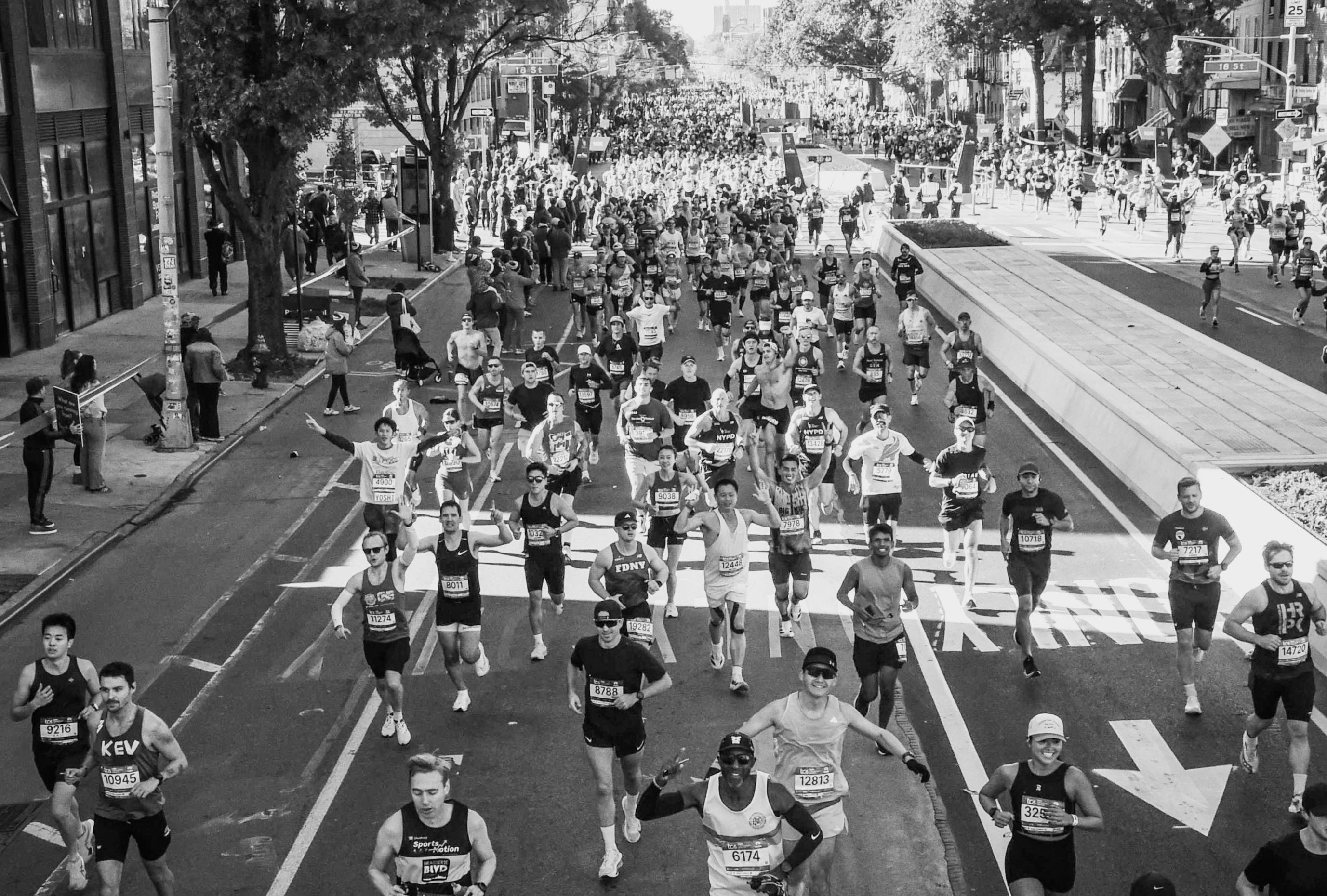
(1) What is the greatest race? The answer is ill-defined. Running is an amorphous thing, less a sport and more a vast canvas upon which we express our intentions, styles, and ambitions. Art is, we’d hope, immune to quantification and resistant to hierarchy. Races ought to be as well.
Still, some races can stake claims to being particularly notable. Boston is the stuff of legend, the world’s oldest annual marathon and a mecca for elites worldwide. Chicago’s fast and flat course makes it ideal for athletes of all stripes vying to break personal records. Western States and UTMB, among the crown jewels of the 100-mile pantheon, have been standout benefactors of the recent boom in ultrarunning. And every runner must be nostalgic for something instrumental in their own journey: the 5K that began it all, the trail race that brought them to the mountains, the half-marathon where they realized they were stronger than they thought.
Yet with all things considered, through another lens the answer is clear. No race can match the magnitude, emotion, movement, and sheer energy of the greatest day in the greatest city. Nothing comes close. It has to be the NYC Marathon.
(2) Nature has no better way of reminding you of time’s passage than when autumn arrives. The winds pick up and take the fallen leaves with them. You start to track the sunsets, feeling whiplash from when it was bright at 8 a couple weeks back. Hoodies and Patagonia vests swarm the streets, decorative gourds flood the windowsills, and pumpkin spice returns to the menus. The fact that another year is entering its closing months blasts you like a furious gust of frigid air. Fall has crept up again and taken you by surprise. The silver lining is that it becomes really nice for running.
Since they both occur on the first Sunday of November, the Marathon always syncs up with the end of Daylight Savings, making the weekend a double bellwether for the cold and dark months ahead. But unlike Daylight Savings, which hits the clock abruptly, crudely, and often unknowingly to the hungover Halloweekender, there’s a palpable buildup prior to the Marathon. Ads appear in the subway. Banners announcing “MARATHON ROUTE” hang from streetlights. By the Tavern on the Green, crews start erecting temporary structures, precursors to a finish line that’ll materialize soon.
Seek it, too, and you’ll taste an anticipatory mood in the city, the cumulative sum of charged emotions from tens of thousands of runners who are wrapping up their training. A commitment to run NYC is a big deal, a declamation of sorts. With marathon prep, running gets realer than ever. The long runs get longer. The speed sessions get speedier. The run clubs get clubbier. Small wonder that you make the race your personality for a month or two, much to the vexation of your friends. It’s exciting to show off on your home turf.
(3) Like most Big City Marathon™s, NYC’s route has remained unchanged for decades. Any modifications would be nigh-sacrilegious given its history and iconic five-borough character. Sons retrace the steps of their fathers from decades before. Pros and amateurs pound the same pavement, separated in time but united in space.
On the last day of August, I emerged from the subway to trace the route’s straight shot up Fourth Avenue. Starting in the shadow of the Verrazzano-Narrows Bridge, I counted down the streets in the Brooklyn grid, glided past bodegas and Methodist spires, and traversed the mediocre canyon of plug-and-play condos. I followed its quick ricochet off Flatbush Avenue into the deciduous sidewalks of Fort Greene and Clinton Hill, its barren pass over the BQE before its entry into Williamsburg on narrow Bedford Avenue, lined with smoothie bars and yoga studios.
A month later I resumed my scouting. I crossed the Pulaski Bridge into Queens, its view of Manhattan so recently obstructed by the characterless high-rises which erupt from the flats of Hunters Point. I paced my climb and descent of the Queensboro Bridge and pursued First Avenue north, replicating the route’s tokenistic mile in the Bronx that weaves around parking lots before bouncing back down into Harlem. I strolled down Fifth Avenue to Engineers’ Gate and finished in Central Park.
Now I could visualize without being overwhelmed. I could imagine how much would happen in those miles. I could not wait for them to come alive.
(4) The most essential ingredient in a marathon recipe is probably the long run, to familiarize your brain, legs, and heart with what it means to run for three or more hours straight. I was tired of my daily slogs on the West Side Highway, and the thought of doing fifteen or twenty miles on an out-and-back along the Hudson alongside thousands of other sweaty runners and cyclists wasn’t particularly inspiring. I wanted to continue exploring my city and uncover more of its character. I could not wander these streets any better way.
For my first long run, soaked in summer heat and under the twilight of a candied sunset, I traverse all the streets in Dumbo, finding my footing on cobblestones and sliding past tourists as if I were in the underbrush. In the industrial parts of Greenpoint I discover a narrow path winding along the dead waters of Newtown Creek, crossing boardwalks of grated metal next to the poop eggs of wastewater treatment plants. I take the PATH to Jersey and see Lady Liberty turn her back on me, stumbling across a secluded Venetian-style development near the ports. I spend twenty miles sweating around Central Park on a frustratingly humid October evening, and by the Harlem Meer I step on a hapless rat.
For my last long run, I saunter with a club from the Lower East Side all the way down to Coney Island via the bylanes of Ocean Parkway, then up to Sunset Park along the waterfront. Halfway through, the morning mist turns into a drizzle. By the time I can see Staten Island, anchored by the twin frames of that monolithic bridge, I am drenched. When we finish in Industry City, I have another twenty-two miles in the bank, with some moderate chafing to back up the fact. There’s a saying that once you’ve finished your longest run, usually three weeks out, the “hay is in the barn”—your training has prepared you, and nothing else will move the needle now. Looking around my barn, I hope my pile of soggy hay will dry up in time.
(5) The NYC Marathon is a particularly democratic race, in the sense that there are several ways, accessible to people of all backgrounds, to get a spot. It’s also a democratic race in the sense that money and proximity often prevail.
You could apply for the lottery, for which your chances of being selected are less likely than being admitted to an Ivy League school. If you’re fast enough, you can time qualify. You can run it whenever you like if you’ve run it 15 or more times in the past, but the caveat is that you must first run it 15 times. You could drop a couple thousand for a bib under the guise of charity fundraising. The most practical choice for locals, though, is the 9+1 program. Finish nine races in a calendar year held by NYRR, the nonprofit behind the Marathon, and volunteer at one, and you’ll get a spot. Eager to run in 2025, I spent evenings at the end of 2023 making my plan, refreshing the NYRR website when signups came out and hauling myself to start lines in the manner that one shows up to jury duty. Demand has only gotten worse since, with races selling out within hours of registrations opening.
NYRR, much like the running trend in general, has become a victim of its own virality, a virality that continues to gain steam. Running is the new “it” trend, but something about it feels more staying, something in line with all the jokes I’ve heard about it being cheaper than therapy and it being an archetypal post-breakup gig. The young and disaffected are trying to find themselves, seeking new perspectives for their conceptions of self. Turns out running is freeing in a way that $25 cocktails, hazy raves, and brunch queues aren’t. Freshly invigorated, day by day new converts pick up a pair of trainers and throw themselves into the rotation.
How fitting that this new fitness empire is rooted in New York. With the 9+1 program, NYRR holds a de facto monopoly on race demand, wielding the hype of the Marathon, a trump card among running events if there ever were one, before a mob of hopefuls like a carrot on a stick. It’s delightful to see a new generation lacing up and discovering themselves. Yet with every passing expression of interest in running NYC, I’ve begun to feel a twinge of concern, even guilt, that the running ecosystem in the city is approaching its carrying capacity, that I’m just another contributor to the burden, and that the adage is proving itself right again: you can’t do anything in this city without lining up.
(6) Now that I’ve solidly established myself as the “running friend”, I’ve received an influx of content on social media documenting what I can only describe as gaudy heroics. Watch me run two hundred laps around this McDonald’s! Watch me run seven marathons in seven days! Get ready with me for my workout! Demo these new super shoes with me! Creators, eager as ever to follow trends, have an additional motive in this case for producing content: an opportunity to flaunt their athleticism.
I have never enjoyed this mountain of runfluencer slop, so coated in layers of glossy artifice. In a similar vein, the massive training programs that corporations like Nike and Lululemon have chaired, though they are forces for good, come off as a little sterile. They clamor too cleanly for your attention.
I find the indie scene much more pleasant, not least because the products they offer feel like more genuine expressions of creative visions, and certainly also because they have a cooler vibe. On Thursday, Tim Rossi, Bandit hotshot and Instagram microcelebrity, premieres a short film in Gowanus documenting his efforts to honor his late father’s legacy at the 2024 Marathon. The next day, he hosts a team relay across the Brooklyn and Manhattan bridges. Nike cancels a 2.12K race due to high winds, so Old Man Run Club organizes its own on short notice on the McCarren track. On Saturday evening, Orchard Street Runners debuts their unsanctioned Prototype Race, with contestants navigating through traffic from Grant’s Tomb to SoHo, rushing past checkpoints and trailed by photographers on bikes.
I’ve felt equal parts touched and annoyed by how effectively brands of all sizes co-opt the little platitudes I like to state about running, of mind over matter, of transcendence, of incremental progress. NYRR’s slogan for the Marathon is “IT WILL MOVE YOU”. I know I will be moved! Their taste is too genuine, my reflections too well-understood. Finally I have found some passion. They know that passion, know how to speak to it, and they market it well. I fall for it completely, another acquiescent sucker.
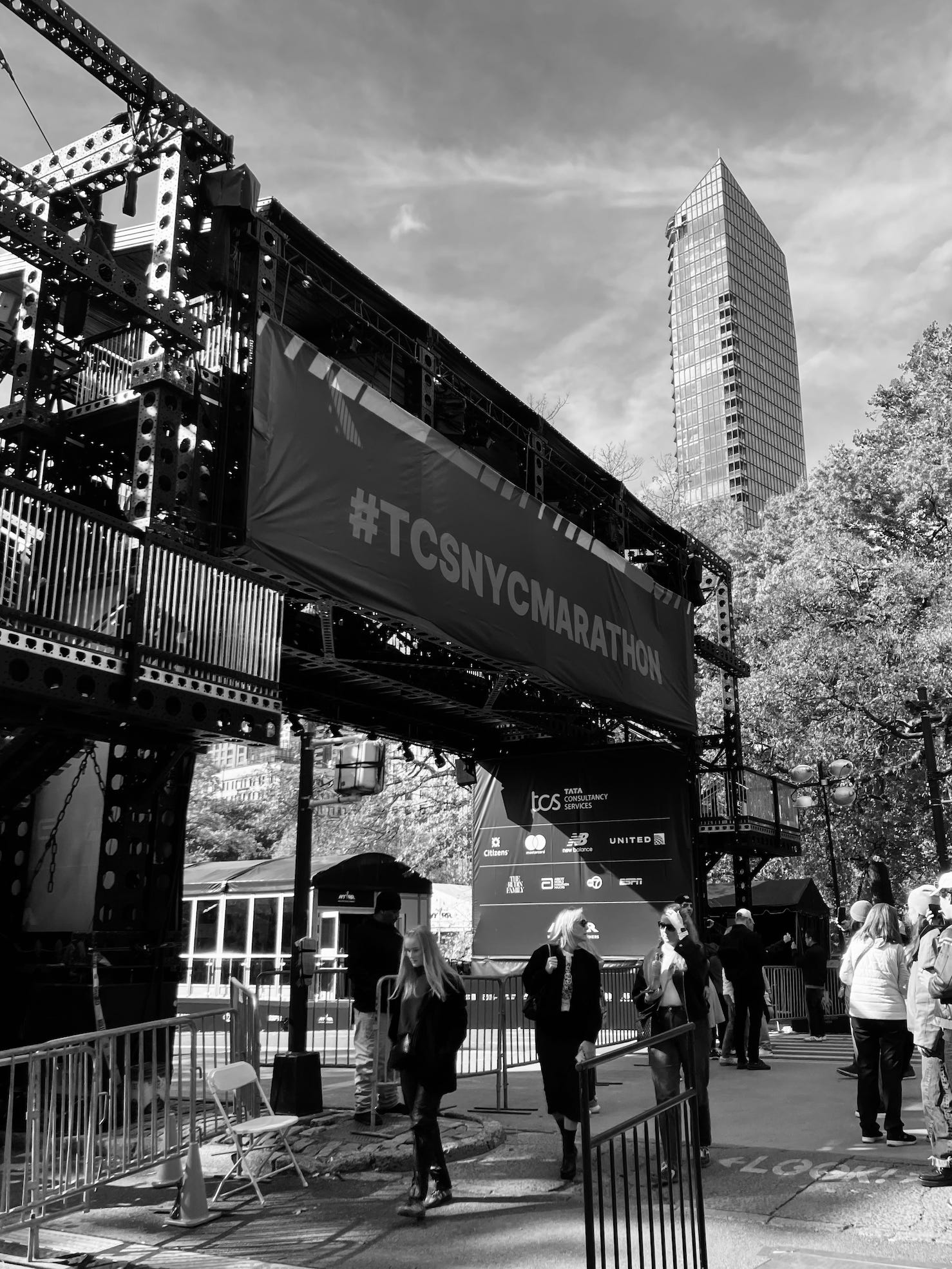
(7) I spend most of Saturday checking out marathon weekend pop-ups downtown, pondering the optimal level of indulgence to have when shopping. I don’t want to spend too much time walking around the day before, but these stores look sick.
I am not someone who particularly cares about how they dress. The Uniqlo shirts draped on my desk chair are good enough. Yet I have grown to become a conscientiously conspicuous consumer when it comes to activewear. I suppose it is because I have developed a keen awareness of the way I’m perceived when I’m performing—every run is a tacit performance, your body, form, and stride distinguishing you to whomever you pass—and also because I’ve developed a sense of vanity where I care about looking good when I’m at my best, a twist on the conventional pursuit of beauty. Indeed, I time a haircut two weeks before race day so that I’ll look sharp in the photos.
(8) Here’s a fact I’ve been hiding thus far: as of yet, it is regrettably impossible for me to talk about marathon training without talking about injury.
I am prone to it. Flat feet, brittle shins, and a callous disregard for moderation when ramping up mileage do not mix well, it appears, and insoles and calf sleeves can only do so much to mask the mess. Three weeks into an intended twelve-week buildup, I did a set of 800m repeats that were a bit too hot in more ways than one. Waking up the morning after, I felt a familiar tenderness along my tibia, and a familiar sensation of dread. My periosteum, hotly inflamed, had not liked that provocation.
The next two months were a balancing act. Shin splints are an ambiguous pathology, following a continuum of severity. If the inflammation is minor and doesn’t affect the bone, the pain can go away fairly quickly and it’s possible to keep running, ensuring the intensity is light and exercising extreme caution. Push more, though, and you’re toying with the possibility of a stress fracture, which will put you out of commission for at least a month. Generally, one does not resolve overuse injuries with more use, but with a race you’ve been looking forward to on the line, aborting training can feel more crushing than an injury itself. So I followed what I’d done in the past, a protocol for the knife’s edge: limiting runs to three a week, spending a superfluous amount of time on the bike and hoping that some of the cardio gains will transfer, actually stretching for once.
Still, the cumulative distance that I stacked up over the fall ended up being less than two-thirds of what I’d hoped to have covered. Instead of laying on base-building mile after mile, I’d inched ahead on a tightrope. I used the taper in the two weeks before the race, where one lets off the mileage to recover and consolidate gains, to end my gambit. I was not happy with my progress, but it was not time to mope. Next time, I could be wiser. For now, I was lucky to still be on my feet. It was time to execute with whatever I had.
(9) I prefer not to listen to music when I run, finding it generally distracting, but I admit that a good album can help the minutes pass by.
One album that was on repeat during the training block was Never Enough, by the hardcore punk band Turnstile. It’s in many ways a companion piece to their preceding album Glow On, which garnered acclaim for its synthesis of traditional hardcore elements—feverishly shouted vocals, formidably nasty riffs, and a pervasive sense of high-octane intensity—with moments that resist categorization into genre—samba beats, cowbells, subdued intros that relax the tempo. With Never Enough, Turnstile leant even heavier into this style, to the extent that it would be misleading to label it a hardcore album. Some songs devote half their runtime to interludes, quieter sequences illuminated by pulsing layers of synths and minimalist ostinatos, in one place an extended flute solo approaching ambient territory.
The album’s structure is polarized and polarizing. The excessive back-and-forth between production and reflection, loud and quiet disrupts the overall flow of the music and verges on the edge of being gimmicky. This exact quality, however, is what makes it such a great running album, not just an album to listen to while running, not just an album whose lyrics start with “running”, but an album that conveys the spirit of running. The shifts between the harshness of concentration and the freedom of contemplation, a dual intentionality and automaticity. Melody, rhythm, and their dissipation. That’s what it’s all about. The fluidity, then the focus.
(10) I suffer badly from race-day nerves, and often cannot sleep the night before. This time around is no exception, and a double-dose of magnesium and melatonin proves futile. I lie flat in bed and stare without seeing, hearing my heart pounding like the tolling of a bell under my chest. It has never felt so deafening, this anxious beat. When I doze off, I dream about having trouble sleeping. I wake up thrice. The second time, I see that my phone reads 3 AM, and I’m relieved that I was at least able to sleep through the extra hour.
(11) Watching NYC inspired me to write a piece on the sights and sounds of spectating last year. I had come home that day with a bag of emotions and cast them into words. I wrote, then:
I won’t wax poetic here about the gruesome beauty and the meditative struggle and the transcendental love that goes into running, lest I add to an already oversaturated realm of writing. At the least, I’ll save that for those who actually completed the marathon this year.
Now that I have run the Marathon, it’s my turn for poetry.
(12) At 5 AM, I get up, swig a cup of beet juice, and inhale some rice congee cooked the evening before. I grab my gear: more snacks, anti-chafing cream, six energy gels (three caffeinated, three not), and a Gatorade. I put on my super suit: navy singlet on navy half-tights, bib already attached to avoid a last-minute fuss over positioning and name written upon it as per tradition, toe socks, and carbon-plated shoes. I throw on some outer layers I’ll later donate—moving items from Staten Island to Central Park is a logistical feat NYRR is unwilling to tackle, so everything you take to the start you must discard or carry with you on the course.
It is dawn. Walking to the ferry, through reams of shadow I glimpse the occasional runner en route, too. The sky is a deep, deep blue. The crisp silence is punctuated only by the lone clang of a volunteer’s bell. By 6, I am gliding across the Upper Bay, together with several hundred other runners who are mostly staying seated and talking sparingly in the interest of conserving energy. This is the beginning. Footsteps in the dark, the collation of souls, the huddling of bodies, the transport of biomass, a vague murmuring, a pilgrimage of steel over the waves, a red gradient growing over Brooklyn. The city stirs and anticipation brims.
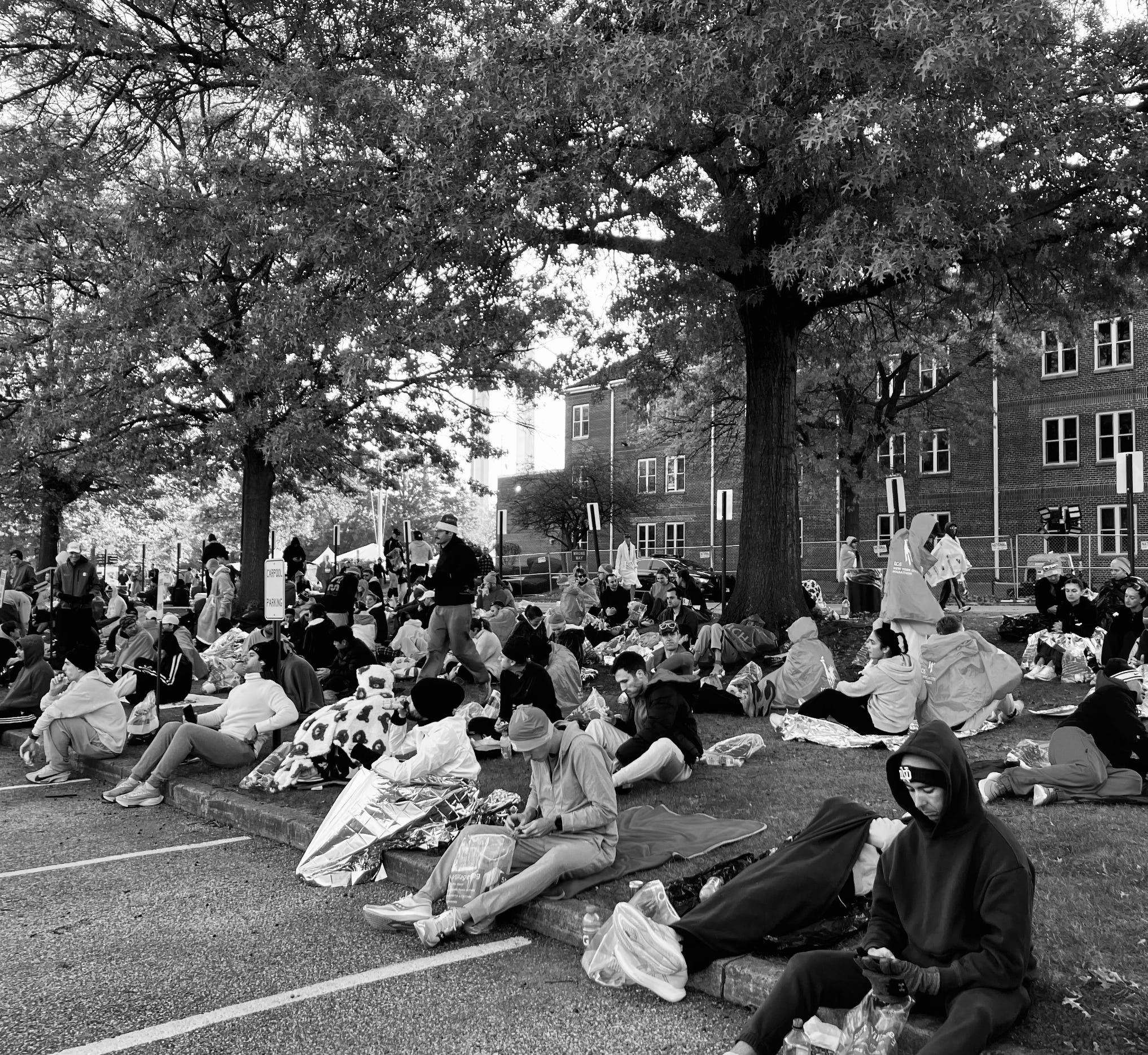
The start villages, through which nearly sixty thousand will pass this morning, take over much of Fort Wadsworth by the base of the bridge. “Village” is a generous term; “staging area” is more like it. The sun is low in the sky and its rays reach over the trees. Above there is a constant pulsing of helicopter blades from police and news outlets keeping watch. By white tents, volunteers hand out bagels, charity teams take group photos, and people queue for therapy dogs. With over an hour to go before the first contestants set off, many of the runners in the first waves have ample time to kill. Some jog around the parking lots, stretch against poles, and practice strange warm-up routines. Many have brought cheap towels and blankets, laying them on the grass and lying down in the world’s most lethargic and aloof picnic.
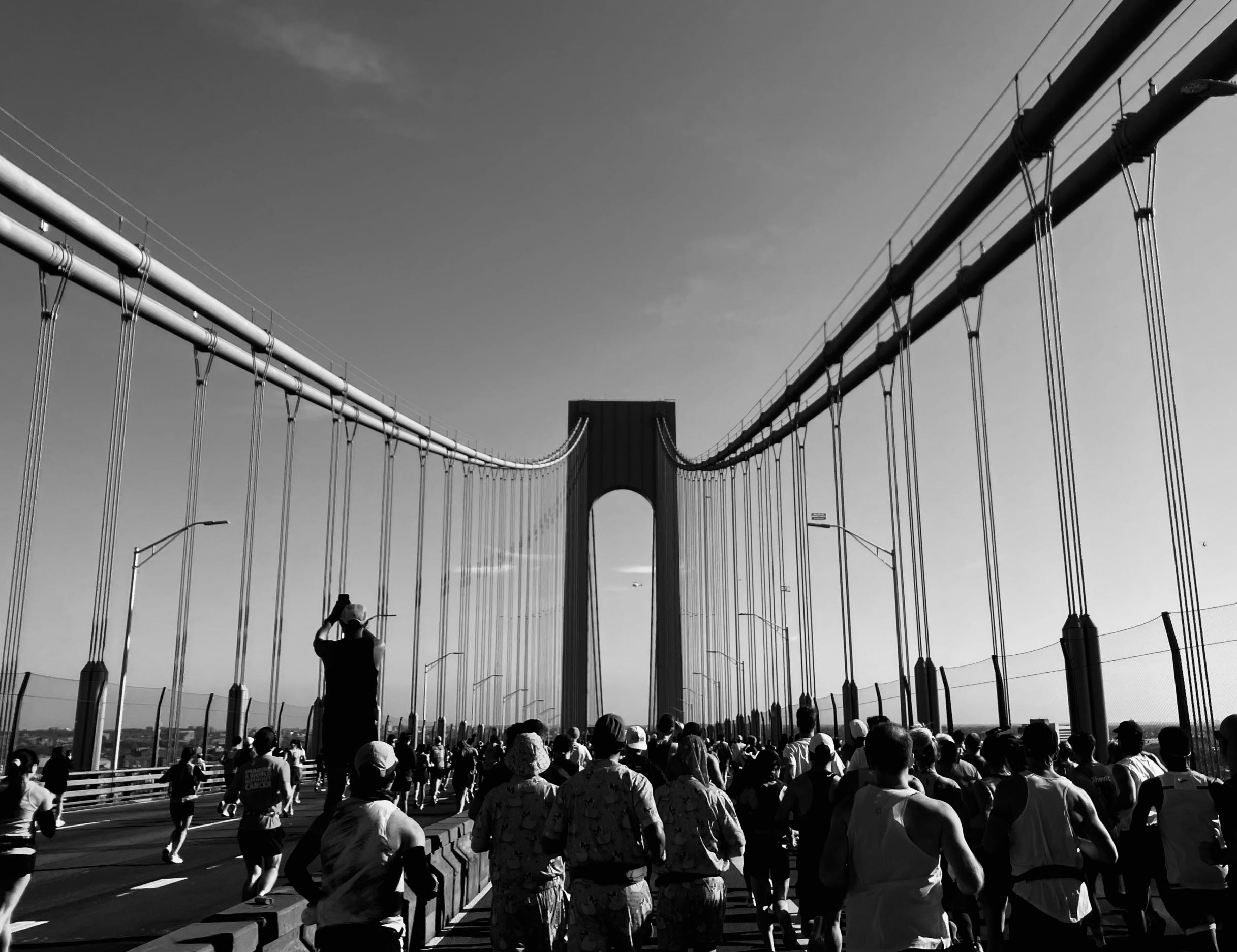
Twenty-five minutes before the start, the corrals for Wave 1 close. There will be five waves, three start routes per wave, six corrals per route: ninety distinct pens will ultimately be herded onto the course. With no shortage of nervous bladders, the porta-potty situation becomes untenable. Volunteers begin directing people toward the bridge, and immediately all the men, driven by sudden urgency, leave the line to go to the bushes to pee. Walking onto the bridge, its magnificent size becomes apparent, seventeen lanes of concrete wide enough for a town plaza, a scale not made for humans but captured on this day. Bunched up behind start lines and teeming with cortisol, we look like a bungling squadron of soldiers. Then a dull thud, white smoke ahead, another buzz of helicopters, Sinatra’s crooning voice, a lurch in the front, and a tide sweeping you forward. Go.
(13) The opening stretch is difficult to handle, a two-hundred foot ascent and descent over the Narrows. Treating them as a cautious warmup and making sure to not trash one’s quads out of the gate, in a well-paced race the first and second miles will constitute the slowest and fastest splits over the entire course. Three immense ribbons of people ripple down the exit ramps into Brooklyn.
Fourth Avenue, with its minimal elevation, will be the easiest it ever gets. As it passes through mostly middle-class neighborhoods, the crowds are only modestly raucous, primarily parents and children offering tissue boxes and with arms outstretched for high-fiving. Because the legs are fresh, the mood is optimistic, and the initial adrenaline rush still rings, it’s easy to go deceptively fast. Careful, for every surge and every weave consumes a bit of fuel, and too much showing off will all but guarantee burnout by the end.
With the pain still low and the road flat and wide, it’s easy to phase out. The buildings blur and spectators blend together in a mass of color. With every minute thousands of bodies go by. How quickly they pass. My cadence and stride are instinctive and dialed in. I am a part in an assembly line, on its way to become something bigger. I am a boat pulled by the current. I am an animal in a stampede.
(14) If running is a study of opposites, there is no better exemplar than NYC. Being the world’s largest marathon, its dichotomies are outstanding. In order to handle the challenges that come with sixty thousand participants, logistics for the event are optimized and streamlined to a tee. Steps and processes are laid out mechanically to keep variance to a minimum. Bib pickup is at Javits Center Thursday through Saturday. These pace groups go into those corrals. Water and Gatorade every mile with these volunteers. Yet the excitement of the experience is enhanced by, not detracted from, these factors. Somehow, the fact that you are not all that special makes things all the more special.
In the structured chaos of this dual parade, miles upon miles of runners seeing spectators and spectators seeing runners, the distinctness of persons dissolves, and the atmosphere becomes one of anonymity at unparalleled scale. You do not watch humans, you watch humanity. Except then it happens. A familiar face, a bib number duly memorized, a yelp barely heard, a quick detour, a newfound burst of motivation, a fly-by measured in seconds and remembered forever. There are countless encounters of fleeting intimacy and camaraderie, each one dissolving the amalgam and providing a moment of electrifying clarity. Celebrating the many and recognizing the few, sonder succinctly expressed.
(15) South Williamsburg, between miles 10 and 11 of the course, is mainly populated by Hasidic Jews. This is not jogger territory. This is the domain of black suits and fur hats, mothers pushing strollers, and schoolbuses marked with Ktav Ashuri. These folks are not fans of the race, considering that tight singlets and split shorts don’t exactly epitomize tznuit. In fact, in the days before the race, posters with red Hebrew text appear on Bedford Avenue, cautioning Jews to avoid the street on Sunday, especially if they’re with children.
Here’s what the posters say. In the Bava Batra, one of the tractates of the Talmud and part of the Oral Torah, which is the holistic code of conduct upon which Rabbinic Judaism is rooted, we are asked (on page 57b) to consider the scenario of women washing their laundry along the river outside. (Remember, this is over two thousand years ago; there are no laundromats.) To prevent getting wet, they roll up their sleeves and raise their hems, exposing their skin. Then those brazen enough to gaze upon them surely walk the path of wickedness. By Isaiah 33:15, they have failed to “shut their eyes against contemplating evil”, and submitted to their carnalities. The pious will search for alternate routes to avoid the sight, and if that is not possible, they must still compel themselves to avert their eyes. Is it not right, then, to avoid the Marathon, that river of impropriety and immodest feast for gentile pleasures? If you must look—may the Lord help you.
Unfortunately, it’s hard to stay away from Bedford Avenue if you’re walking around. The road basically splits the neighborhood in half. Thus the “silent mile” of the Marathon is the strangest stretch of the course. There are few spectators, and the pedestrians that you do spot are mostly hasidim crossing the street while trying to act as if the Marathon does not exist. Of course, outright ignorance is a recipe for disaster, since you’d be instantly taken out by a runner if you ambled obliviously onto the pavement with eyes closed. In reality, the hasidim sprint across like hikers fording the rapids, a sight that is equal parts entertaining and confounding. They are playing Frogger, and we are playing Mario Kart.
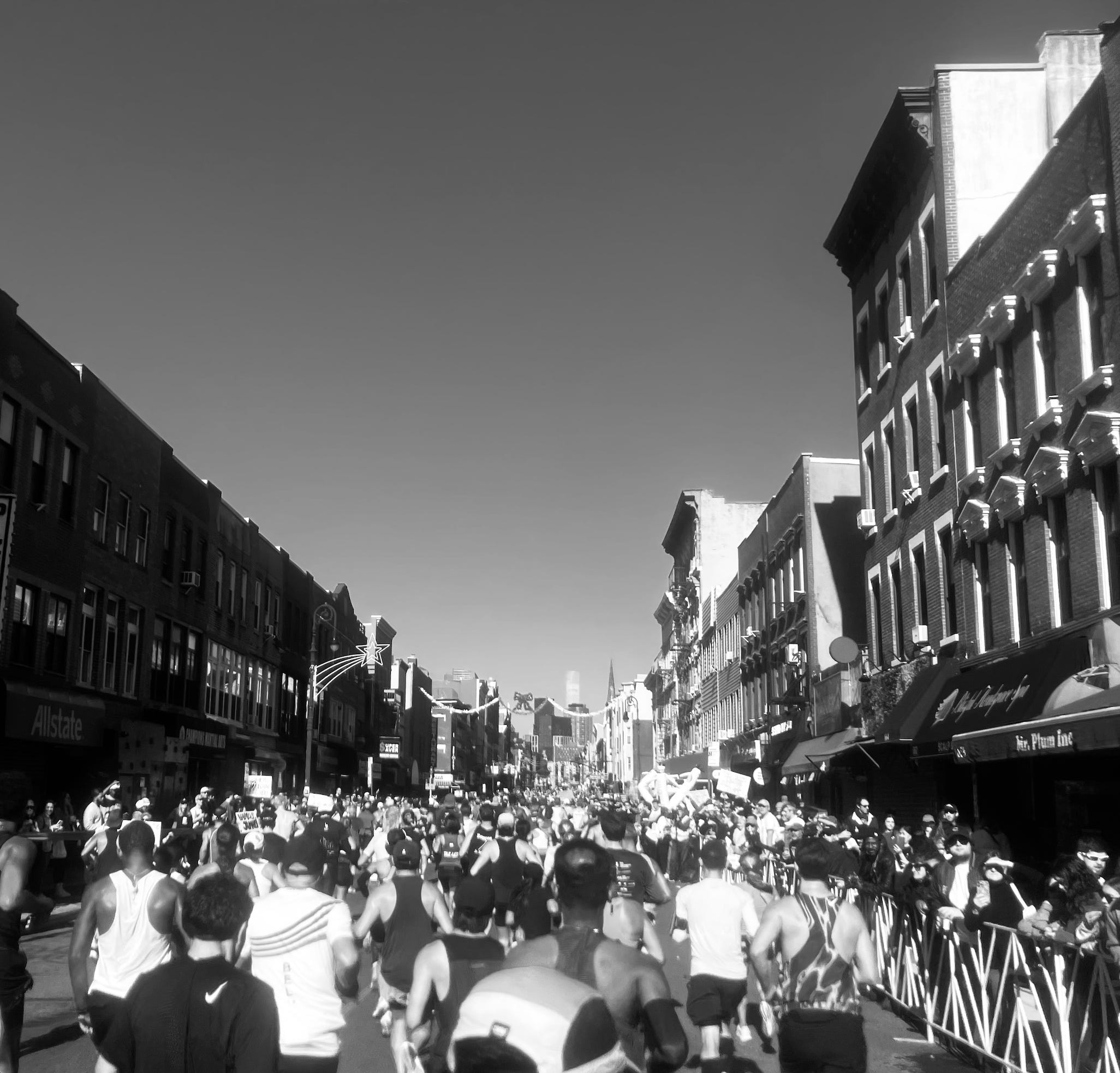
(16) In the first half I feel astonishingly comfortable. My heart rate has never been so low at this pace, my feet feel weightless, and my breaths are unstrained. I was also able to spot most of the friends I was aiming to see, a higher hit rate than I’d expected. To keep myself steady, I remind myself of how easily it can fall apart.
When I run I feel like more, and in a race I am superlative. I am young, ardent, dynamic, a touch insolent. I leave it to my body to express my brashness. At the same time, I am at my most essential, with my frills stripped away. Thoughts condense and evaporate in mental homeostasis, and I’m impressed at how easily I can discard distractions and hunker down, I who am otherwise so easily interrupted. I rebel against the passage of time, cast myself outside of it. But I remember, somehow, also to hold my stride, and keep my mile splits in mind.
(17) If the Willis Avenue Bridge at mile 20 is the strategic crux of the Marathon, since that’s where many start to hit the wall, then the Queensboro Bridge is its emotional counterpart. You have just crossed the halfway point and done a quick rip through Long Island City, where the glass skyscrapers throw the sunlight around and a drumming band amps you up. Then you begin the climb over the East River. One left turn and you are on the lower deck of the bridge. It is dark, the concrete is rough, and there are no crowds. If you’re teetering on the edge, this mile is a strenuous psychological test. The only sound is the pattering of feet, the heaving of breaths, maybe a yell or two from the pacers. The sound of determination is like heavy rain.
The bridge softens, flattens, and inverts. Opening your stride, you take the first exit to the left. A small hum manifests in your ear, and with each strike downwards, it grows. It sounds like a hidden waterfall you’re approaching around the corner. After a sharp U-turn, the walls suddenly recede, and you see it. A revelling mob welcomes you to Manhattan as you slingshot yourself onto First Avenue.
I think about one of A Tribe Called Quest’s tracks from their final record: solid wall of sound. I’m not listening to any music, but that’s only one of many songs in my head right now. I’m thinking about Nas telling me that the world is mine, Tom Verlaine witnessing lightning striking itself, and Julian Casablancas assuring that I’ve got everything under control, this rich tradition of New York artists rooted right here in this city. I don’t hear songs playing, but I feel music everywhere in these streets.
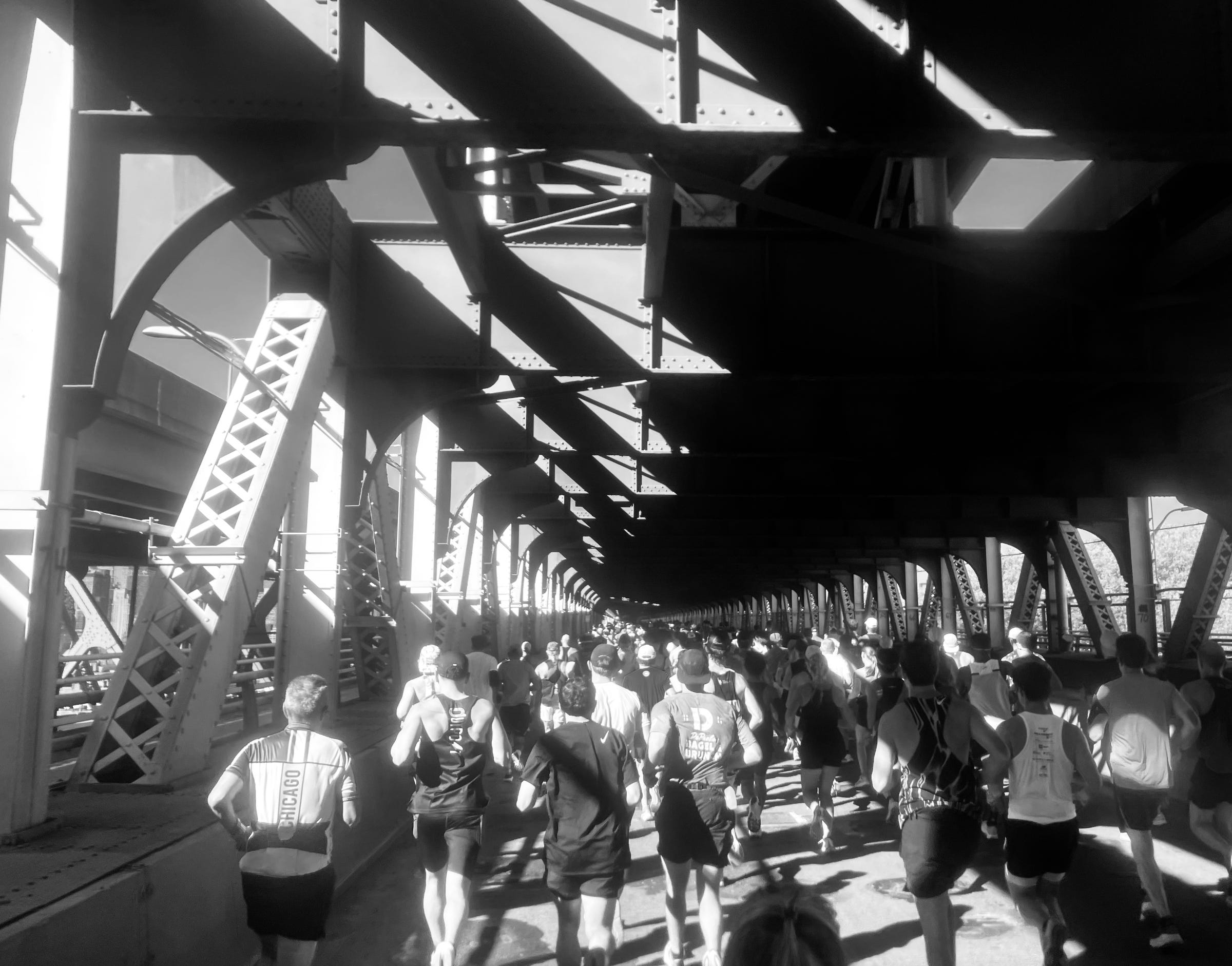
(18) I start getting a little emotional, and I harness the numbness of my concentration to maintain my composure. I’ve been looking forward to this for a long time. It’s been in the back of my mind with every NYRR registration, every long run, and every energy gel purchase this year.
Is it possible to anticipate sentimentality? To relish an experience before the fact, for the sweetness of your expectation and reverence to provide premature gratitude? I have to remind myself that this is really happening, and I cannot believe that I have the immense privilege to be a part of it.
New York, I have run your streets, but I have never run them like this. It’s a city-wide party. Choppers roaming, voices roaring, crowds watching, arms reaching, hands waving, fingers pointing, signs dangling, bells ringing, drums striking, sirens flashing, subway groaning, pacers calling, cups splashing, confetti firing, cameras snapping, mist spraying, pigeons scattering, leaves falling, sky blue, sun bright, wind cool, breaths heavy, mind light, quads fiery, calves straining, mouth dry, neck wet, head up, eyes straight, chest forward, elbows bent, back firm, arms swinging, hands tight, feet sore, skin salty, hair swishing, screaming, crying, laughing, whispering, chanting, panting, sweat, gels, water, saliva, tears, vomit, hard asphalt underneath. Humanity at its best, one of the very rare phenomena that can stake a claim to being unambiguously good. The pandemonium and exertion of it all feels a little like war. But really, this is the antithesis of war.
(19) The pain makes itself known on the Upper East Side, as glycogen reserves run low and muscles start showing signs of fatigue. For this reason they say that the real race begins in Manhattan. I’m starting to regret my wanton efforts earlier, taking photos on my phone, parceling out high-fives, tilting my head to look for people, and yelling at strangers to turn it up. As my resources deplete, I decide to stop playing. I take no photos and say no more words until the finish.
At this point, the crowd can become adverse. It diverts your attention and feeds off your energy as the race evolves into a battle of attrition against yourself. As the streets tick up I see more and more people slowing down, stretching out cramps, slowly fizzling out. They’re in for a rough day, with more than ten kilometers to go. I maintain my speed through the Bronx, but I know that my bearings are starting to loosen, and I feel a new weakness as I cross the Madison Avenue Bridge back into Manhattan, as if my quads could implode at a moment’s notice. Through Harlem my form begins to degrade. My legs hit the ground a bit harder, my head bobs a bit more, and my breathing becomes heavier. I think this is okay; the closing stretch is the time for last-ditch efforts and compromises. I think about how many miles I have left, how many more minutes I have to suffer, and use these mundane calculations to stifle the protesting of my body. Still time passes at the rate of one second per second. Still the celebration. Still the noise.
(20) By time, a perfectly-paced marathon should be run with even or slightly negative splits, where the time taken to complete the second half of the course is slightly shorter than the time taken to complete the first half. But since most of the hills in New York are in the second half, going for a slightly positive split is also an acceptable decision.
By feel, a perfectly-paced marathon should be like this. The first half should be smooth and calm, almost a little too easy. Through mile 20, you should start feeling increasingly uncomfortable, but manageably so. In the last 10K, you should be in immense pain as you try to hang on to your pace and your mind slowly descends into a fever dream. If you execute right, you should be delirious after the 40K mark and unable to remember much of the last few minutes.
There is nothing wrong with running a marathon at an easy tempo and taking maximum enjoyment out of the experience. But racing a marathon warrants some consideration about the spice level to set. One way to think about it is that each runner has their own monotonic function that maps pace to a number x between 0 and 100, indicating that they have a x% chance of finishing a marathon at that pace. You want to aim for a pace where x is considerably less than 100. Maybe 50, so that the question of whether or not you blow up before the end is a coin flip. The important point is that such a function exists for everyone. So when professionals drop out mid-race, it’s not because they’re unprepared. It’s probably because they took a calculated risk that didn’t work out.
My first cramps hit on Fifth Avenue, south of Marcus Garvey Park and north of 110th Street. I think I curse but no sound comes out of my mouth. This is a very common, and very embarrassing, place to falter, since it’s in the final five miles but comes right before the last big hill of the course, a gentle slope up the side of Central Park which feels like nothing on fresh legs but amounts to a mile of agony this late in the race. To walk up this hill is a walk of shame. Contrary to popular wisdom, the latest scientific evidence seems to show that cramping doesn’t necessarily occur because your body is low on electrolytes; usually it’s because your muscles aren’t resilient enough and have begun to give. Fair enough. I’m not surprised to find myself like Icarus under the sun.
It’s time to troubleshoot on the fly. I gulp down more Gatorade for good luck, and radically adjust my stride to avoid contracting the muscles in my calves that have ceased to cooperate. Going up Fifth Avenue my shoes are barely leaving the ground, and I look more like I’m skipping. I regain my form somewhat, straggle through Engineers’ Gate into Central Park and barely manage to hear some friends shouting. I look back and somehow I don’t look hideous in the photos they take. With each tiny hill I cramp somewhere else, and repeat my problem-solving choreography. I lose a few minutes on my finish time, but miraculously I never walk. In the grand scheme of things this would hardly be considered a blow-up.
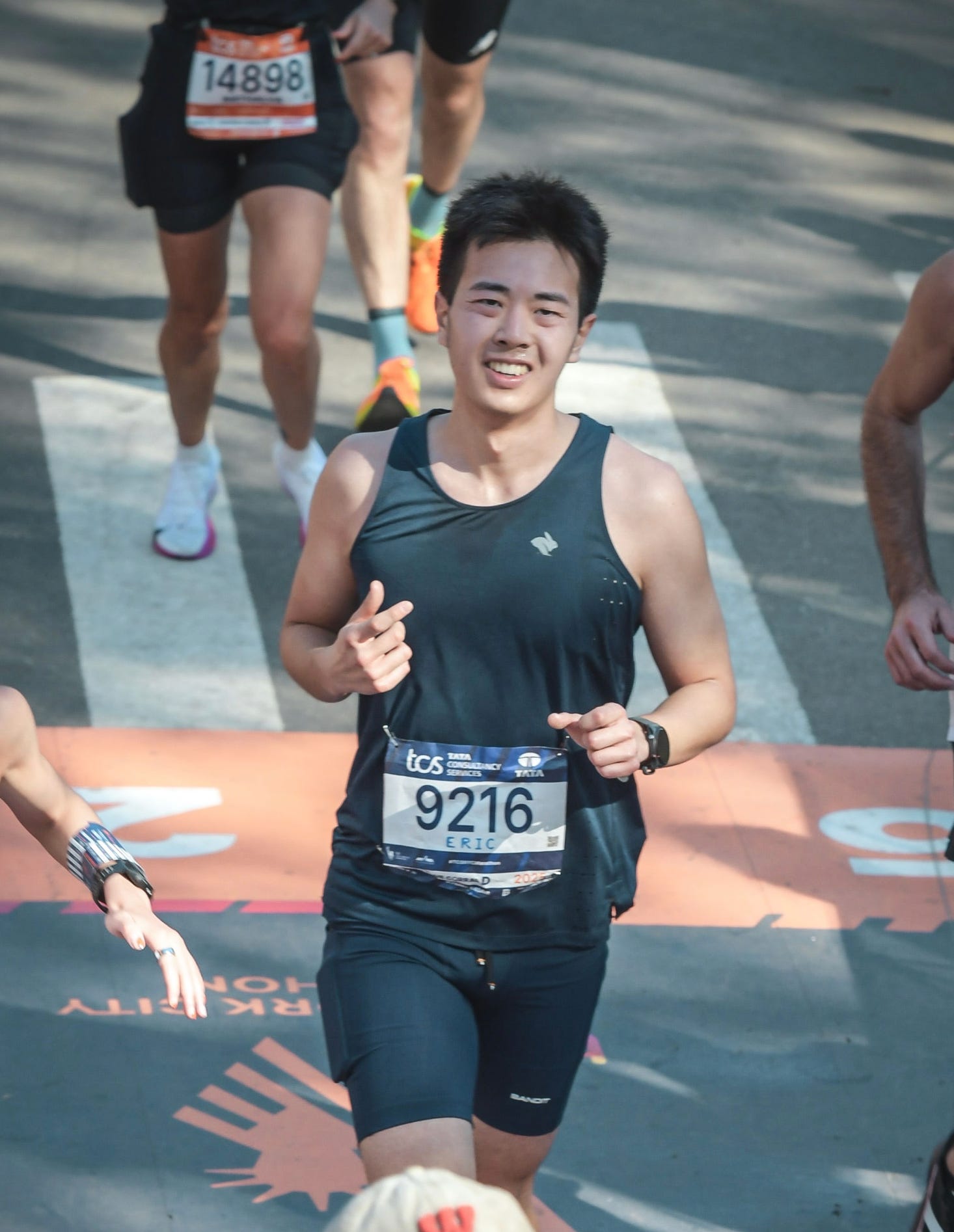
Coming out of Grand Army Plaza I run right past my parents, who have flown in to see me, and I do not notice them at all, too embroiled in the depths of my resolve. There are more photographers on 59th Street and I guess I instinctively notice them, because there are photos of me grimacing and pointing at the cameras online, which I do not remember doing at all. I have only vague images of a path back into the park, flags flanking me, a sign saying 200 meters to go, and a plastic timing mat beneath my feet. Excellent. Just the right level of disorientation.
In the final photo across the finish, I am smiling.
(21) I sidestep around some barf and creakily shuffle forward. My body instantly switches to repair mode, because walking suddenly becomes difficult. Sadly, there will be a lot more walking to do, for there’s a long exit chute for finishers to pass through before they emerge on Central Park West.
The atmosphere is quite similar to the start, lethargic and aloof. Everyone stumbles forward in their super-shoes, draped in bright orange heat blankets, again a bungling squadron. Most are too exhausted to talk. My cell reception is throttled to death with the crowds in the area. There are speakers broadcasting a recorded message with exit instructions repeated in several languages, but I reckon that few are listening, and instead asking themselves the same question: Okay, now what?
(22) For me, the greatest day of the year was over not long past noon. For a day spent outside of time and etched in eternity, it sure did pass by quick.
If running transforms you, there is hardly a better place to seek transformation than in NYC. If marathoning changes you, then no marathon will change you more than this race.
Not so long ago, on a weekend run I shared a brief conversation with an older runner who’d moved to Queens a few years prior. I asked them when they had started to feel like a true New Yorker, and they told me that it was the day they ran the Marathon.
(23) There is a certain comedown, as if sobering up after a high, the following week. Finishers hobble around melodramatically in New Balance marathon jackets, pleasurably whining about their sore legs. At the Nike SoHo store, the line for free medal engraving services wraps around the block. My social media feed is filled with recap montages. I start humming Sinatra and I don’t even listen to Sinatra. I check out the YouTube video for his “Theme From New York, New York”. All the comments are either about the Yankees losing in the playoffs or Mamdani winning the mayoralty. I am strangely emotional; maybe my hormones are out of balance.
(24) I guess I’m proud of how I executed. My finish time was 3:14:21, a smidge under my goal of 3:15 and with splits of 1:36 / 1:38, better than expected considering my cramps. I hope this comes off as reasonably impressive to the novice. I’d like to say that being in the top 8% of finishers makes me eligible for modest bragging rights.
At the same time, there is a certain perspective under which my race pace—a little quicker than seven and a half minutes per mile—was pathetically slow. Among a certain subset of my friends, that’s an easy pace for conversational runs. I know there’s a lot of room for progress. My training block was bullshit, duct-taped together under the specter of injury, so I’d like to say that most of my potential was untapped. I want to refine my discipline, and I’m itching to see what can happen when I take advantage of compounding growth over the months and years to come. With luck, this will be the slowest I’ll be for a long time.
There’s another positive externality to getting faster, which is that in races, you’ll be more easily spotted by friends because you’ll be at the front of the pack. You’ll also look more aggressive in the photos. Not to defend my egoism, but if it’s ultimately aligned with accomplishing outcomes I’d favor anyway, who am I to judge?
(25) For the most part, folks like me—young, educated, the new gentry of the information age—live in a world of solved problems. The hard work of our preceding generations has given us a safety net. We are not driven by needs. Opportunities and risks abound, but there are no longer challenges that are fundamentally crucial to our continued, day-to-day survival. At work, we have the unprecedented luxury of avoiding manual labor, but instead we sit at desks and have our brains do all the pulling while our bodies atrophy. We spend our days online and on screens. We lack purpose and we are left wanting.
We seek outlets to put ourselves to use, ways to chase some platonic toil and the gratification it provides, third spaces, and the chance to fully own something. Thus we come up with games to play. We tell ourselves to “do hard things”, whatever that means. The criteria is arbitrarily construed by our own ideals. Banks and consulting firms offer a certain trade to the exceptionally hardworking and directionless among us: work your ass off since that’s all you know to do, and ye shall receive an established system of prestige and a ladder to climb. Socialites crave control and community, relentlessly navigating and spinning webs of connections and relishing the power they broker. Entrepreneurs covet “agency” and “impact” and go to great lengths to dress up their ventures in fluffy rhetoric. There’s a kind of altruistic grandstanding in their attempts to portray their own hustling as somehow more righteous than everyone else, and their belief that their millionth B2B SaaS idea is key to humanity’s flourishing.
With running, I’ve simply chosen something much more straightforward and relatively untainted, something more tangible. In a post-scarcity world, it makes remarkable sense to go back to the simplest tradition, that with a close link to our natures and with a pure conception of achievement. It’s so easy to desire, to just say the words: I want to go faster and go further, I want to keep going. I want to be great.
(26) Ours is an age of commitment issues, not only in the relationships we have with each other, but with the relationships we have with ourselves. The median younger recreational runner I meet nowadays is not someone who I would describe as particularly avid, nor particularly candid. They are someone who has bought a pair of shoes and will admit that they would want to “try” a half-marathon or what not, but aren’t willing to muster the mental energy needed for dedication. Or they’re afraid: afraid of failing, of being below-average as if a hobby entirely determines their worth, of being characterized as a “runner”. Instead, they adopt the same half-ironic, unserious tone that pervades our interactions and pursuits. They hesitate to display their passion and allude to their goals in circumspect ways, masking their attitude in defensive language. There’s the denial or disavowal—“I actually hate running, it’s so terrible”. Or self-fulfilling diagnosis—“my cardio’s too poor, I’m concerned about my knees”. Or the rejection of identity, because standing for something is burdensome—“oh, I only dabble”.
Running is now a virtue signal, the new blessed way to be ostentatious about mindfulness and health. If virtue signaling leads to more time spent outside, more time connecting with others, and more time setting constructive goals, I am all for it. But the true richness of running doesn’t come from half-commitments. Nor does it come from parading around medals, gloating online, or recklessly trying impressive-sounding feats. It comes from the patience of slow and easy training, from listening to your body, and from consistency above all. I want to take this seriously; I want to embrace this unabashedly; I want to be sincere. I am in the business of inculcating conviction, of doing things well, and of earning what I pursue.
Two weeks after the race, I am running again. I am back in the streets of New York City, these streets I know so well and will never know fully, these streets of hope and despair, respite and bravery, light and shadow, joy and sorrow, thought and action, these streets of life, these streets that I can run forever.
(26.2) I would not recommend this race to first-time marathoners. The course is difficult, and it sets the bar too high.
Hey, great read as always. Your insights on the meaning of 'greatest' realy make you think. This piece beautifully expanded on your previous take on pushing human limits. Loved it!