
Ultra
silent immolation in the hills of Vermont

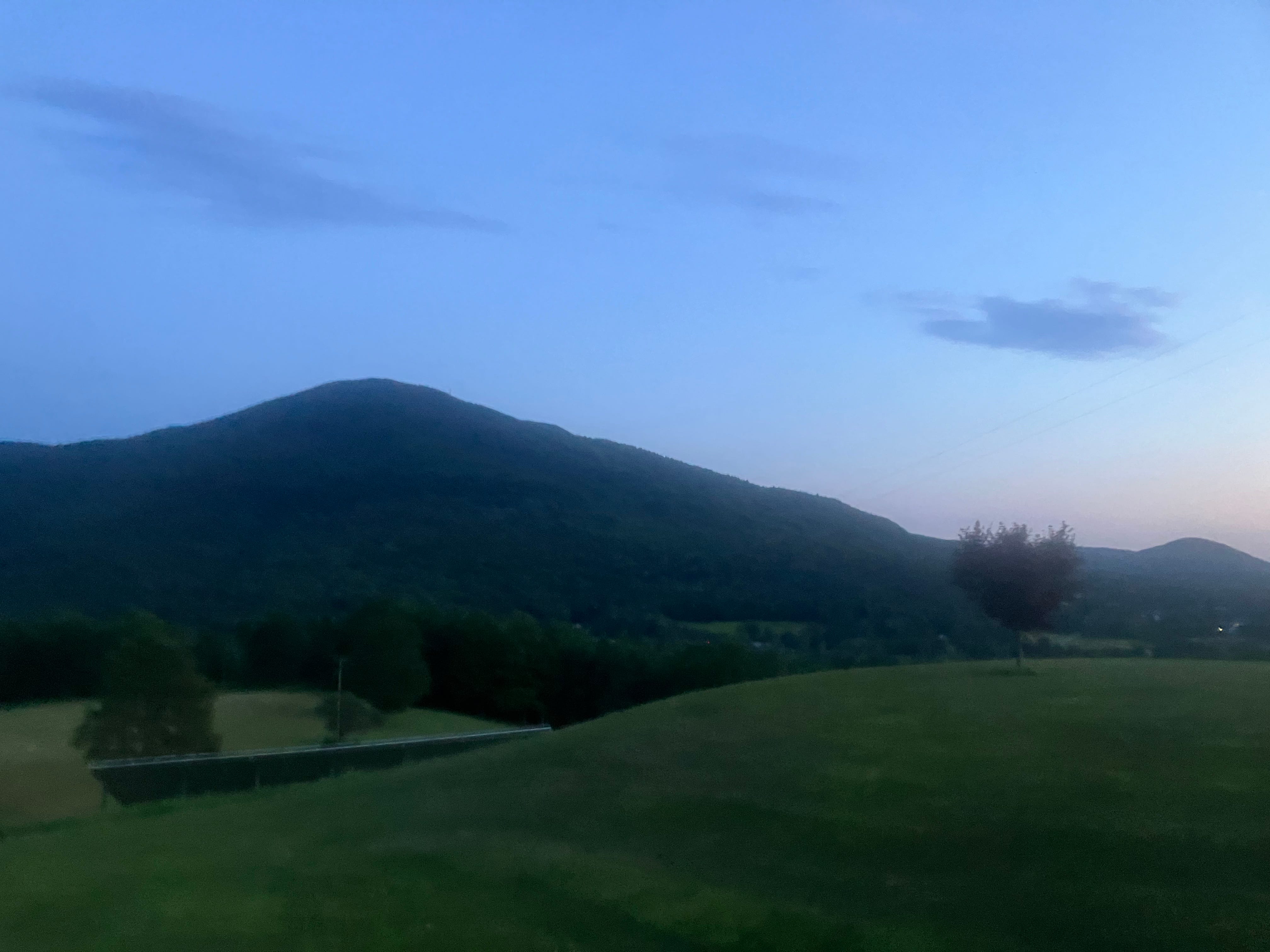
It is at eighty kilometers in that totality washes over me. It is the dying time of summer day, the straggling intermezzo of dusk, when night settles slowly and seeps through the firmament. The sun has retreated and carried its scattered flames with it but its halo lingers, loath to leave. As solar ectoplasm drains from the infinite above, the sky displays its departure in colorful fluctuation, tinges of fading white and fuchsia and peach and gold and then profuse blue, like descending into an abyss of endless sea.
There is cool now after a day of pounding heat, merciless radiation that parches the trees and dries the soil into dust that is kicked up and made to wander by warm winds, wafts of powdered earth and dried leaves blowing across roads of white gravel like sinuous thread trailing off to the vanishing point and broad chartreuse meadows of long grass radiating moisture. In the evening these winds turn gentler somehow and offer a soothing touch upon salt-streaked necks that assuages the toil of the longest days of the year. There is chirping and the nightsong of flocks alighted upon unseen boughs and there is rustling in the brush from the stirring of nocturnal denizens. The whole is cursory shadow, a landscape that is one extended afterimage.
But now comes the dark, and in the countryside its oppression is perhaps more severe than the sun’s. It defamiliarizes everything, it heralds unknowing. Through straining eyes, shapes blend and trunks merge and plains stretch and the canopy dissolves into a restless boid. There are clouds blocking the stars, leaving only black. Black pressing down weightlessly from above, the universe’s true color, a shade of nothingness. Black filling the air with intangible thickness, so dark you cannot see your hands in front of you nor your feet underneath, a drowning uniformity that renders all unseen, no longer a distinction between ground and sky, some strange aftermath in the wake of the entire world’s abdication. Black as the essence of absence.
I have turned onto a side path off the gravel road and I pass a sign that reflects glaringly the glow of my headlamp. NO OUTLET. It leads to a clearing idly sloping downward, following the contour of the hill. Behind looms the mass of Mount Ascutney, its summit not more than four kilometers away past the valley and brook and highway. Through the half-light its profile is still clear, tears of defunct ski trails streaming down its northern face, leering impassively if not kindly, a placid monolith reminding you of scale and distance when those concepts have almost lost meaning after hours of forest and field.
To the right is a barn, its planks variegated and roof slanting grayish in the gloaming and incandescence pouring out of an opening. An aid station. People have gathered here among half-unfolded lawn chairs and duffel bags and plank benches scattered on the ungroomed grass. I recognize some faces who stayed with me at the cabin we’d booked the night prior and they call out to me: Hey, you look like a million bucks. I make the grave mistake of sitting down to eat and it will be ten minutes before I find the will to rise again. There is a spread of granola bars, Oreos, BBQ chips, soda, and ramen broth, fuel for the long and slow haul. I’m graciously offered a sampling. It’s a midsummer eve and I’m twelve hours into voluntary oblivion, on a farm above the vale, facing a man I met a day ago, pastoral father figure transient, who is offering me a cup of pickle juice.
What the fuck am I doing?
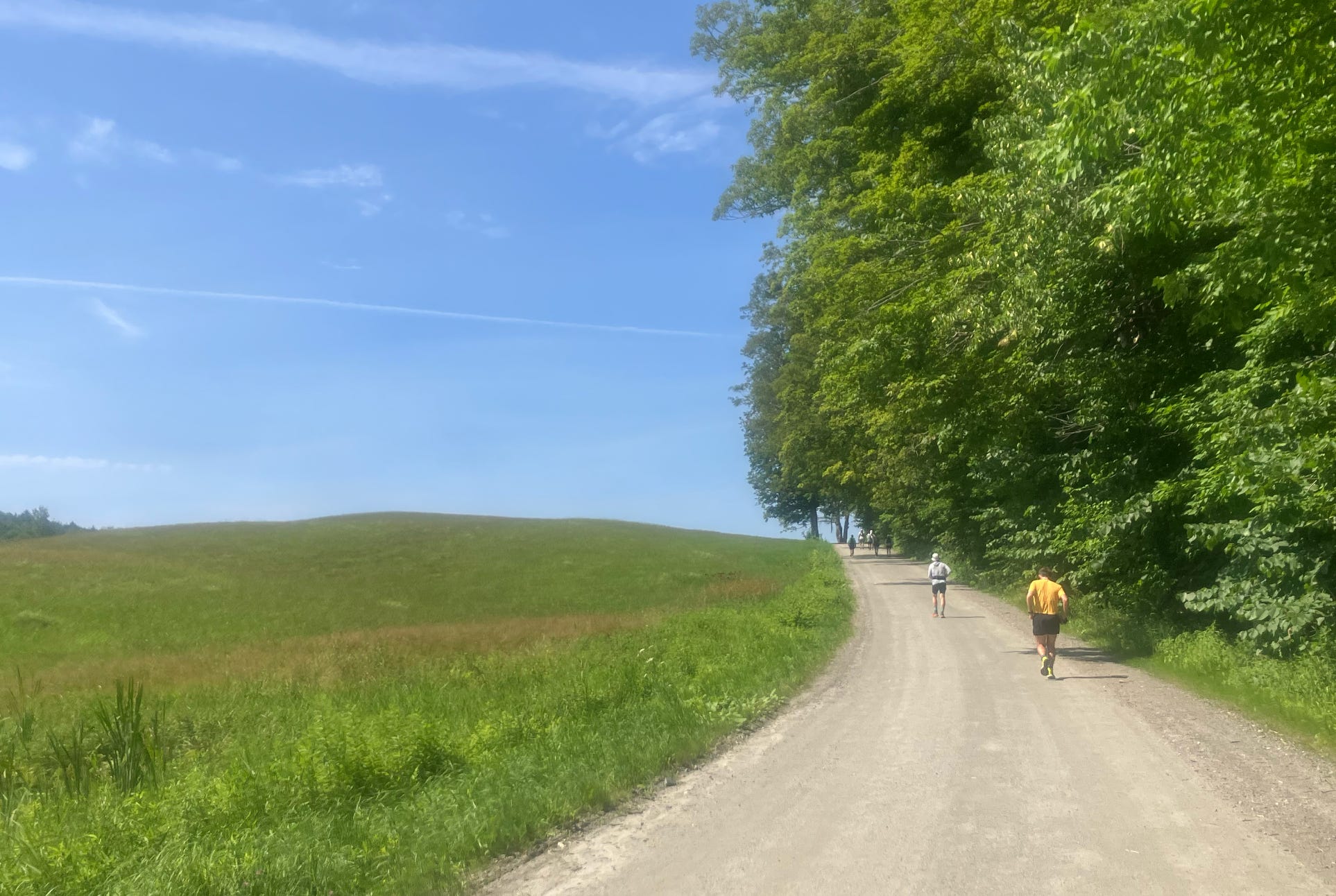
If recreational running is a reaction against modernity, a prescription for the crises of meaning we face today, then ultrarunning stands as a logical and almost inevitable extrapolation of that quintessence: a response, or admission, to the truly absurd. In cultural recency the marathon has become blasé, a templated prototypical goal around which has been manufactured a leviathan of pride and accomplishment, a meticulously-produced and well-packaged hero’s journey for the masses. These days one might garner that it is more tractable to run such a race than it is to hold down a fulfilling job. Yet to worship the marathon distance is nigh frivolity. Why should we think that running another five minutes mutilates the act? Why can’t we go further? Distance is an experiment, a number which we treat as a game to play. Lest we forget that we are the principal investigators and the writers of the rulebook, and twist our own agency to confine us to yet another form of bondage to prestigious figures: distance is meant to have no bound.
From that perspective of running qua personal prerogative (or sentence) to freedom, the verdict is clear: if we are curious how far we can go then we ought to just do crazy shit for the sake of it. We ought to endeavor for more, to let time melt and minds strain, to let our bodies break and recompose beyond what we knew was tenable, to think bigger and then stop thinking. Whence the “ultra”. We use base ten, so 100 is a nice round number, as arbitrary as any other. How about we try running that distance in kilometers? One unit is as good as another; why not miles? How about 250, sleeping overnight under the Arizonian stars? How about 3100 around a single city block in Queens, to be completed within 52 days, dawn to dusk?—such is the aptly-named “self-transcendance” project which several dozen ascetics undertake in the waning days of summer each year. The numbers stop making sense. This is deliberate. Alternatively, why not change the metric? One loop per hour on the hour, done until the last man standing: that is the “backyard ultra”. Completing the Appalachian trail, or the Triple Crown, or all the 14,000-foot mountains in the contiguous United States, or traversing the country, your journey serving as a story you have told without needing to speak a single word, and doing so faster than anyone in written history has ever done before: that is to set a “fastest known time”.
The reasoning and justification might be trivial, but then again, from a sufficiently reductive perspective, so are the totalities of human endeavors, so verily nobody is the wiser. We probe too obsessively for gratifying origin stories, for rationales, for impetui, but so often inception is naught if not a whim, and it is instead the practice of continuity, that mystical nature of becoming, that yields the boon. “Ultra”, the term meaning “beyond”, but “beyond” is a relative thing, a recursive notion when layered upon itself, one that carries itself into the infinite.
Scarce a surprise, accordingly, that the ultrarunning realm is characterized by a dissolution of the form and structure present in the milieu of shorter races. On the road everything is precise, formulaic, virtually mathematical. Most ultramarathons discard this in favor of the trail, through forest and mountainside and sometimes stream, over dirt and rock and root. There is a degree of cruel humor at play. As if trekking all day wasn’t daunting enough, there are a couple thousand meters of elevation to climb and descend as well, with technical conditions to keep a weary brain alert to boot. Things can occur during the long and melting hours that simply do not happen in road races. Mosquitos, wasps, ticks, larger wildlife, mud, water, rock scrambles, wrong turns, sunburn, blackouts, inclement weather, sleep deprivation, nutrient depletion, hallucinations, psychosis, and catastrophic muscloskeletal failures, for instance. The improbable becomes acute, and improvisatory problem-solving is almost always necessary. By trading rigidity for fluidity and jacking up the variance, these events distinguish themselves as organic foils to the synthetic air of the pavement. Time, speed, and performance are not so much the onus as is the subjective experience of hyperbolic persistence, which may well stake a more persuasive claim to being a representation of “true” endurance. A representation that itself manifests in a far less romanticizable image, anyway, given that the discipline is from the outset a giant misnomer. Most ultrarunners spend very little time truly running, but rather trudging onerously, their overtaxed muscles unable to withstand forces more intense than those of walking. “Ultra”—the term here perhaps too meaning “slower”.
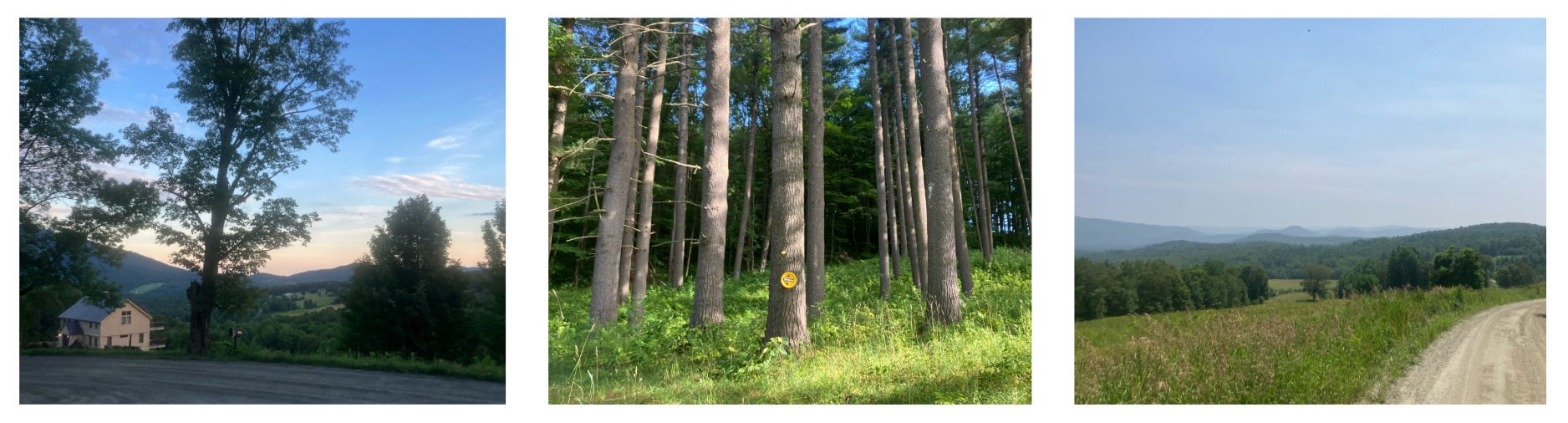
The Vermont 100 winds among the rippled innards of the southern half of the state, great folds of land that oscillate gently and ceaselessly. To the south and east lie the Connecticut River and the monadnock Ascutney. To the north and west are the principal Greens with their chalets and quasi-alpine pistes. These are the meek hillocks laying between the larger prominents, a patchwork of ochre cambered fields connected by meandering unpaved routes and serpentine unnamed driveways to neat carmine brick houses languidly quaint during the day but eerie upon nightfall, transfigured then into flat shapes of shadow with lines too straight and angles too exact against the umbra of the surrounding weald. Pastures and cropfields scythed out misshapen on the slopes of undulating wolds rising from the bases of anonymous creeks, the settlements of humans themselves seemingly microscopic on the surface of some non-Newtonian fluid congealed across the terrain.
There is no cell service. Every mile or two along the path there is a junction or village of no more than a handful of buildings. Without notice to the side of the highway there might sprout a lone unmarked trail, its path covered by leaf and sapling and scrambling up a local tump to a vista relished by none except the few entitled to this open secret, where one can see on a sultry afternoon the endless layers of Appalachian spine dissolving into the horizon, a discrete gradient marking rungs of mountains stretching across the leagues ahead, bridging a palette between dark olive earth and pale parched sky. Or to a clearing where unadorned markers of stone lay erect in the grass marking the resting places of singular bloodlines whose progenitors may well have first settled these acres. Or a covered bridge preserved across centuries, a pool formed by a dimple underriver, a cultivated wood adorned with small trail markers whose varying stages of decomposition illustrate in some peculiarly elegant way the slow process of reclamation by nature. These are sporadic blooms upon this earthen patchwork to which is added for 30 hours every year the gourmandizing tents of aid stations and the darting of crazed runners undertaking with abandon a rustic odyssey of entirely their own accord.
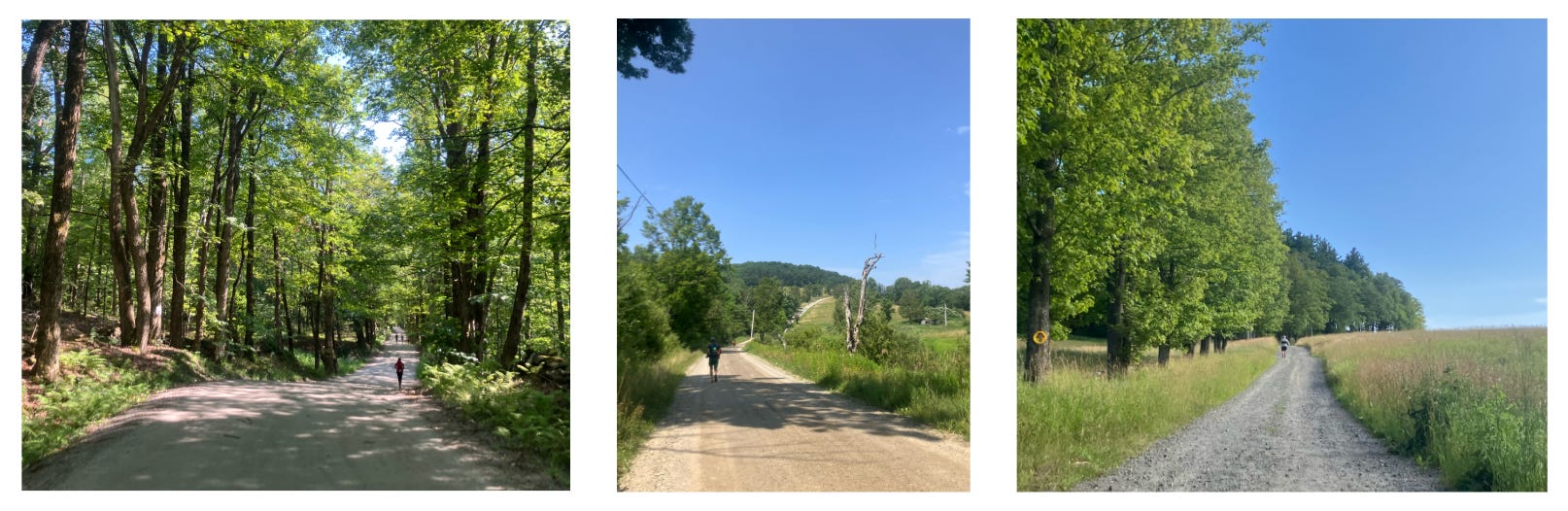
I’d be lying if I said I could recall every part of the 100K to you. I wouldn’t, even if I could. Much of the race traverses private property, its route only made possible through the superhuman enterprising of the race organizers whose logistical savvy has secured the benevolent cooperation of several dozen landowners year after year. So when I look back on that day, I mainly recollect a melange of flickering images of dirt driveways, rail fences, craggy doubletrack and class four roads, stately farmhouses behind manicured lawns and belligerent placards averring “POSTED”, and hundreds of black arrows duct-taped on reflective yellow pie plates guiding me every quarter mile, ground never flat, continuously rising and falling like the chest of some breathing terranean gargantua.
Within this continuum there are moments of piercing clarity. At the start line, I witness the leaping of a toad among dew-laden blades. The same day there is a 100-mile race along the same countryside, those wayfarers having departed at 4 in the morning, five hours before me; before I even reach 40K (their 100K mark) the leaders have already swept on past me, overcoming with silent fury on calves like weathered trunks. Climbing up a chute of sludge, straight up a hill with no switchbacks to be seen in mud up to my shoelaces and wet leaves and stones positioned perfectly for rolling ankles. To anchor a mind spinning, counting down the numbers until the next aid station, each tick of the hundredth point ten meters on my watch. A fleeting spark of rage at the 40-mile mark as I come within a half-kilometer of the start and finish with the parking lot and organizer tents and crayfish pond into which finishers often jump visible off to the side in the golden hour. An aid station at 70K staffed by four spunky volunteers dressed in cow suits head to toe ringing bells and yelling at the top of their lungs. A bristle of nausea under a callous July sun punching shifting pinholes through verdant crowns to be followed by a still more indurate night. A Hobbesian feeling upon tasting the state of nature. Nothing but matter in motion.
Because ultrarunning represents an advanced stage of the rabbit hole, an example of a pastime that resides wholly within the tail of a distribution, the community it’s associated with starts to dip into the genuinely weird. These folks are a different breed. They preach intimacy, intimacy with pain, approaching the erotic. The top trail runners talk about the pain cave, the relationship between body and mind, id and superego, to treat your corpus as a machine to be studied—e.g., it’s an empirical question of how much sodium and carbohydrate you should intake per unit time, for the stomach is a muscle; it’s an empirical question, too, of figuring out meditation strategies that work for keeping calm on the trail, for the brain is a muscle too—yet also a vehicle of the divine demanding faithful treatment.
The Overton window makes the visceral strikingly ordinary. After the race I gawk at the several blood blisters that have formed on my feet; I’m met with no sympathy. You can simply pop them with a safety pin, the skin’s all dead anyway, it’s only toe juice you need to release. I learn about the existence of toe socks and nut butter. I’m told how to adjust my diet to optimize my calorie-to-poop ratio, how it can be difficult to figure out if it’s beeturia or rhabdo when pissing ruby red, how to strategically dose ibuprofen, and how your endocrine system can become so fried from exhaustion that your skin will break out in hives.
Idiosyncrasies carry over to the race traditions as well. Finishers receive belt buckles, and there’s a special award for DFL (dead fucking last), the final person to cross the line before the time limit is up. Many folks wear shirts from other competitions, friends camp for the weekend to help crew and pace runners in the latter stages of a race, and there are often as many volunteers as there are contestants. At least for now, ultrarunning is differentiated by its level of authenticity. It’s really hard to grift over these distances. The motivations for going ultra can also come from origins more solemn than just a fervent attachment to a hobby. It can be a way to rekindle autonomy and dignity after trauma. It is converse to addiction in a way where the subject has complete authority. I endured that; I can endure this, too. It is more likely a response to past harm than a manifestation of morbid interest in controlled self-harm, though certainly it serves as a compelling outlet for our innate fascination towards self-destruction. This is purging and catharsis, a tamed and disciplined form of constructive violence, an ecdysis of fouler foibles in pursuit of a cardinal complexion. Homo sapiens are complex tribalistic beasts who decamillennia ago emerged from the steppes and plains and scattered across the Earth on foot across Beringia driven by some genetic compulsion outside of language or reason or narrative to simply advance. No more fitting is there a primordial rite to honor our substance than to romp again across the land ever-stretching, hairless apes atop the soil, not thinking too much about anything, steadily forging personal folklore briefly removed from civilization and celebrity.
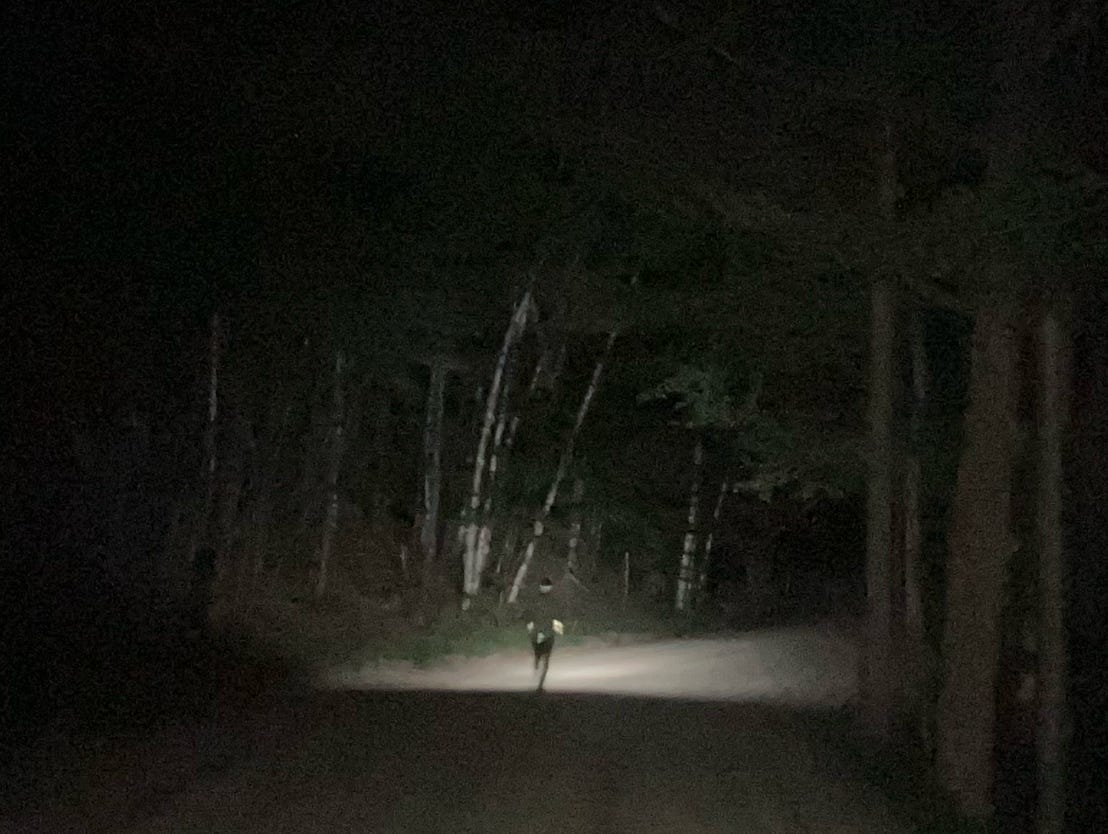
Now back to that night. The barn is behind me and only the oblong disc of light shed by my headlamp illumines weakly the peat and loam underfoot as the road terminates and I enter another patch of forest. I cannot recognize fully the ground. I descend from trunk to trunk, sticking my arms out to break the momentum of gravity as my quadriceps have conceded their ability to absorb compressive force which make it so that each step taken braking downhill delivers a jolt of immense and viscous aching. Another runner passes me, murmuring a quick greeting, with hydration vest lit up in bright white. For minutes I see him trailing away until his phosphoresence dissipates. At the nadir of the entire course I follow the margin of a meadow across a gap between two soft promontories reaching towards the vale as if they were the fingers of a giant’s hand. The sky is a supercilious navy. Soon I am crawling back up the gravel road. Glowsticks accompany the pie plates for navigation and they look like hovering sprites dangling midair from branches and emanating a cool florescent gleam. The serenading of insects and growling of crew vehicles on roads just outside sight. Stalks of birch pale like spindly quills. I pass two runners by the ditch. One of them throws up and their headlamp momentarily illuminates their regurgitate. I move on completely unfazed. I have retreated totally into the vestibule of my mind.
By now I have long been reduced to a grim and gaunt speedwalk, since all other forms of movement cause substantially more pain. The slightest movement of my feet in their shoes scrapes a smidge more tissue off my raw and festering skin. I suppose this would be bound to happen in my first ultra. Too many unknown unknowns before the fact. Nevertheless it’s quite interesting to feel what it’s like to be flying half a ship. More and more people begin to overtake me now that my pace has flagged. They are mostly quiet, carefully conserving their remaining energy.
There are horses too. This is another quirk of the Vermont 100; it claims to be the only remaining 100-mile race in the world with a concurrent horseback course. Much of the route for riders lies on separate carriage paths to reduce traffic, but at the end these penultimate gravel paths are shared. Creatures, then, in the midnight ink. A trampling of hooves from afar, steadily growing. A wordless encounter with an unfamiliar figure of human and equine amalgamated, noiseless except for a dual respiration in the dark. The glance of a spectral steed at the end of the line. Now we are all organisms flattened, cast as silhouettes against artificial light.
In any other situation I’d probably be frightened, but I have run out of emotional capital. Astonishingly I am not at all unsettled by this rural dark, even though I am alone and more fatigued than I have ever been and have solely a hydration vest and two bottles of sugary high-carb mix with which to defend myself against danger. There’s nothing left except a mute determination. These might be my fondest hours of the day, immersed in a perverse zen that arises only when you have stripped yourself bare and depleted yourself totally. In so being there materializes some blurred universal sentiment that kindles a divine unity and stillness experienced only in half-consciousness that makes me feel, at the edge of physical collapse, rather indestructible. The world could never hurt me now that I have become an atom indivisible. In fact today it has already sealed my stupid thrilling toy destiny. It is pushing the ground underneath for me. I know the end, I will be there soon enough.
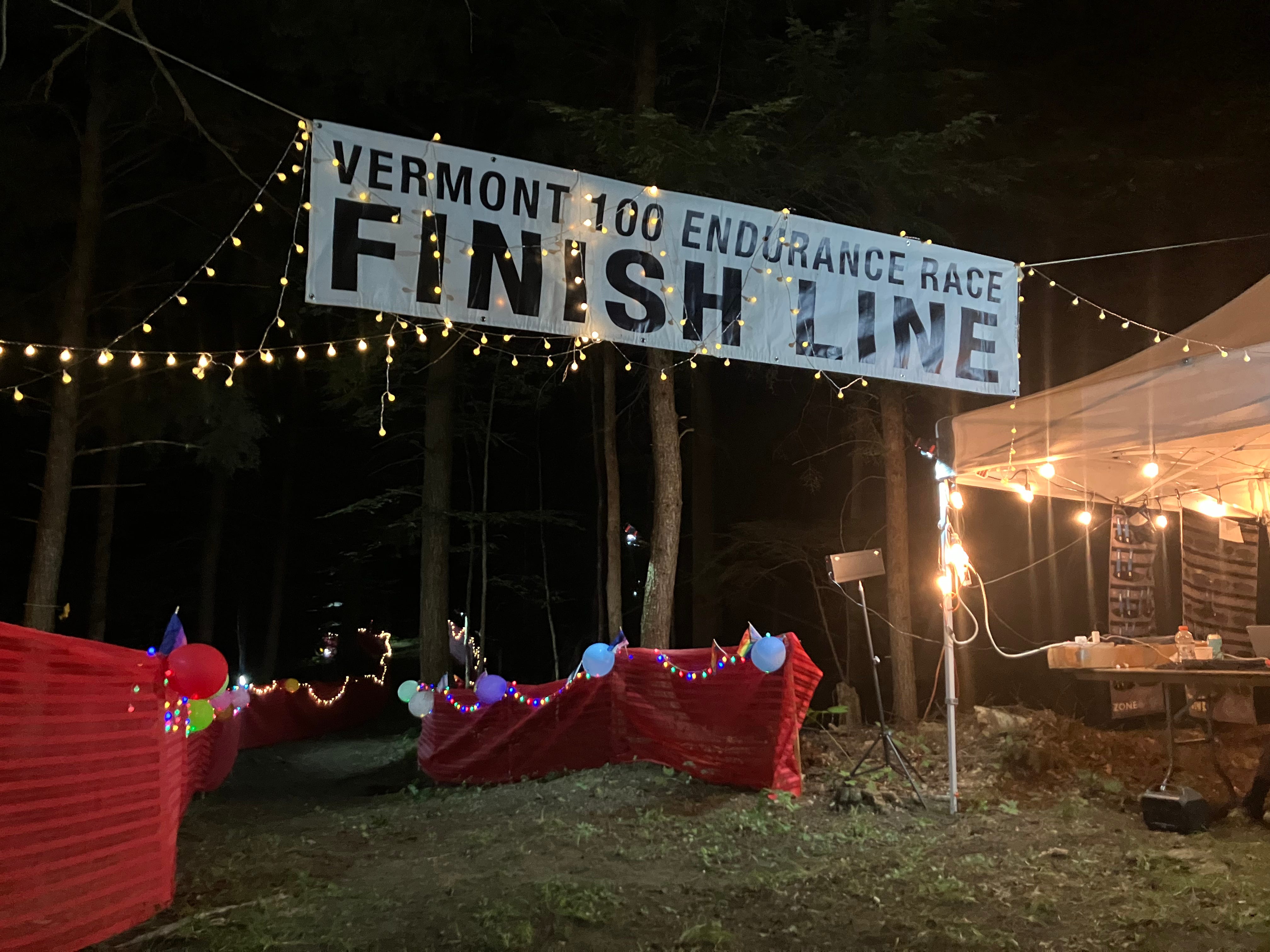
So it’s true that I got it done. I was not attacked by wildlife nor did my tibia shatter on the final climb nor did I black out to be mercifully rescued by someone less foolish this time. I do remember my last couple steps out of the over one hundred thousand I must have taken, which together formed a weak, defeated, humbled little shuffle through a grove decorated with small lanterns and flashing fairy lights in the abject silence like an otherworldly elven pathway charming and vaguely uncanny, concluding with a few meek strides under a big white banner declaring FINISH LINE at which point the timing plate I very nearly tripped over instantaneously sent a signal to a laptop a few feet away which confirmed my victory with a completion time that placed me solidly in the bottom half of the field. It was around 2AM when I gratefully hugged the race director who had been awake and in command for well over twenty-four hours and took pictures with newfound friends with whom I had carpooled up and who were lounging by the campfire so warmly awaiting my arrival, each person emerging from the dark like a dirty, slimy neonate from the womb of the wood or a private personal messiah consummating their own apotheosis. It was over an hour later that we stumbled back to drive back to our lodging to get some rest, picking up along the way a peer who had earlier retired to the medical tent, eyes closed and lying horizontal on a cot with arms folded across the chest all sarcophagial.
Of course as with all things there are fractal details upon details that I’ll choose to leave unsaid. The zaniness of everyone at the awards ceremony the morning after teetering about, grown adults and parents stumbling like toddlers or impaired patients relying upon invisible pairs of crutches. An impassioned dialogue on the Ricardian theory of rent during the car ride back. How I left my phone in the car after being dropped off at my apartment and therefore rued bitterly the paucity of accessibility infrastructure in the subway system whilst embarking on an agonizing journey to Brooklyn to pick it up. Plenty more commentary still regarding the emerging commercialization of the ultra, the philosophy of the trail, the little world of worship that forms around all outlets of adventure which hearten us to act as better and braver selves. In reality stories are not so neat. They go on and on.
But I’ll just leave you with the ultimate rumination I reach when I reflect upon this bizarre ordeal, which is probably the most extreme experience I’ve willingly attempted. In the totality of that night I think there was something nigh-supernatural present, a sort of enchantment saturated in that permeating twilight and then the dark so pure I could no longer see outward nor inward. Treading then in a plane outside sentiment, feeling no misery or joy but rather imbibed in a haze of persistence, there surely transpired some instance of supersession, some correspondence with a pith normally concealed by our outer natures, forgotten quickly afterward upon a return to the ordinary. Pain caves, numbing distances, absolute prostration—all these are only means for the grotesque transfiguration we intrinsically seek. I must have been seeking too that day, and I wonder what I discovered in my liminality.
I wonder what happened in that totality and if I may ever witness that again. I wonder what I left behind that day. And I wonder what emerged within the woods that night, surrounded by the ultra-darkness of those silent rolling hills.